
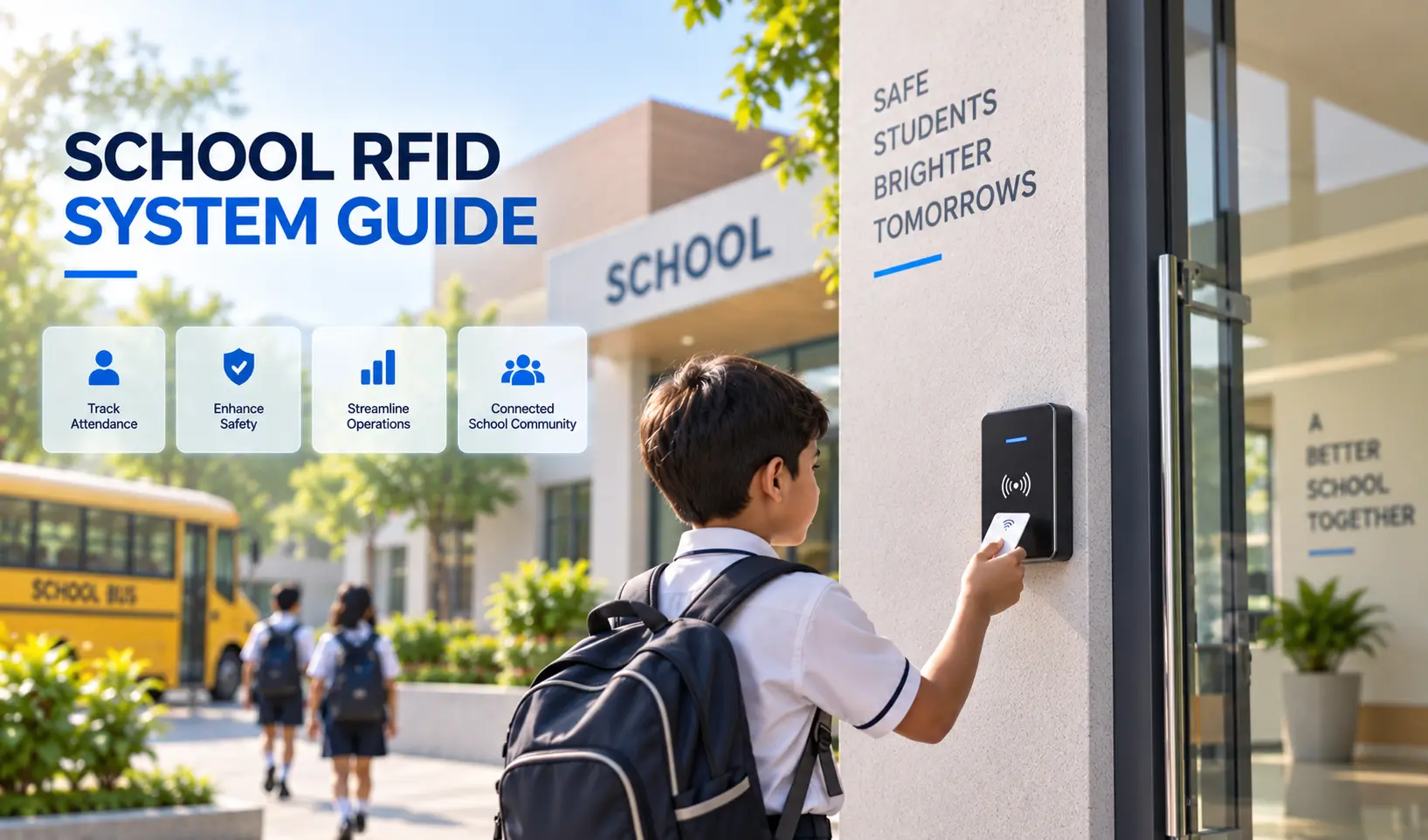
School RFID System: Complete Guide to RFID Attendance & Safety
Key Takeaways & Executive Summary
- What It Is: RFID (Radio-Frequency Identification) uses small chips in cards or tags to transmit a unique identifier to a nearby reader — logging attendance automatically without manual input.
- Beyond Attendance: The same RFID infrastructure extends to bus boarding, library issuance, hostel entry, and restricted-area access — one technology serving multiple operational needs.
- Key Features: Multi-point reader support, real-time ERP sync, instant parent notifications, proxy & tamper prevention, lost card handling, and reporting & analytics.
- Solution: SchoolX RFID System integrates tap-based attendance directly into the broader ERP platform — RFID scan data syncs immediately with the student's attendance record alongside academics and fees.
Table of Contents
- What Is RFID, and How Does It Work in Schools?
- Why Schools Are Adopting RFID Beyond Just Attendance
- How RFID Attendance Actually Works, Step by Step
- Key Features to Look for in a School RFID System
- RFID vs Biometric Attendance: Which Is Better for Schools?
- RFID for School Bus Safety
- How SchoolX Handles School RFID
- Frequently Asked Questions (FAQs)
Ask any school administrator what eats up unnecessary time every morning, and manual attendance is usually near the top of the list — teachers calling out names, marking registers by hand, and hoping no one makes an entry error that later turns into a parent dispute. RFID technology removes this friction almost entirely, turning attendance into something that happens automatically the moment a student walks through a gate or boards a bus.
This guide covers how school RFID systems actually work, what to look for before adopting one, and how it connects to broader campus safety — not just attendance marking.
What Is RFID, and How Does It Work in Schools?
RFID stands for Radio-Frequency Identification — a technology that uses small chips (embedded in a card, tag, or wristband) to transmit a unique identifier to a nearby reader, without requiring physical contact or line-of-sight, unlike a barcode scan.
In a school setting, each student (and often staff member) carries an RFID card or tag linked to their profile in the school's ERP system. Readers installed at key checkpoints — school gates, classroom doors, bus entrances, library counters — detect the tag as the student passes, automatically logging the event (entry, exit, boarding) with a timestamp, without any manual input from a teacher or staff member.
Why Schools Are Adopting RFID Beyond Just Attendance
While attendance automation is the most visible use case, RFID's real value in schools extends further:
Eliminating proxy attendance. Unlike a manual roll call, where a friend could theoretically answer "present" for an absent classmate, RFID requires the physical tag to be present and scanned — making attendance fraud essentially impossible.
Real-time safety visibility. Knowing exactly when a student entered or left campus — and being able to instantly notify a parent — creates a genuine safety layer that manual registers can't replicate.
Reducing administrative time. Attendance that used to take several minutes of roll-call time per class happens passively as students walk through a gate or door, freeing up classroom time for actual teaching.
Extending to broader campus operations. The same RFID infrastructure used for attendance can extend to library book issuance, bus boarding, hostel entry, and restricted-area access — a single technology serving multiple operational needs.
How RFID Attendance Actually Works, Step by Step
Tag issuance — Every student and staff member is issued an RFID card or tag, linked to their profile in the school's ERP system during onboarding.
Reader installation — RFID readers are installed at relevant checkpoints: school gates, classroom entrances, bus doors, library counters, or restricted areas.
Tap and scan — As a student passes a reader — walking through the gate, boarding the bus — the tag transmits its identifier, and the reader logs the event instantly.
Automatic sync — The attendance or access event syncs immediately to the school's ERP system, updating the student's attendance record without manual entry.
Instant notification — Parents receive an automated SMS or app notification the moment their child's tag is scanned, particularly valuable for gate entry/exit and bus boarding.
Key Features to Look for in a School RFID System
Multi-Point Reader Support
The system should support readers installed across multiple checkpoints — not just the main gate — so attendance, bus boarding, and access control can all run through the same infrastructure.
Real-Time ERP Sync
RFID data should feed directly into the school's broader attendance and student management system, not sit in an isolated, disconnected tool that requires manual reconciliation.
Instant Parent Notifications
Automated alerts the moment a tag is scanned — particularly for gate entry, exit, and bus boarding — are one of the most valued features by parents, since it removes the uncertainty of not knowing when a child arrived or left.
Proxy and Tamper Prevention
Tags should be difficult to duplicate or misuse, and the system should flag anomalies — such as a tag being scanned at an unexpected time or location.
Lost Card Handling
A straightforward process to deactivate a lost or stolen tag and issue a replacement, without disrupting the student's ongoing attendance record.
Reporting and Analytics
Attendance trends, late-arrival patterns, and access logs should be available as clear reports, not just raw scan data that requires manual interpretation.
RFID vs Biometric Attendance: Which Is Better for Schools?
| Factor | RFID | Biometric (Fingerprint/Face) |
|---|---|---|
| Speed | Very fast — instant tap | Slightly slower — requires positioning |
| Hygiene | Contactless, no shared touchpoint | Fingerprint scanners involve shared contact |
| Cost | Generally lower per-unit cost | Often higher hardware cost |
| Reliability in groups | Handles high-traffic entry points well | Can create queues during peak entry times |
| Card loss risk | Tag can be lost or forgotten | No physical item to lose |
| Best suited for | Gates, buses, high-traffic checkpoints | Single-entry points with lower daily volume |
Many schools use a combination of both — RFID for high-traffic points like gates and buses, with biometric verification reserved for more sensitive or lower-traffic access points.
RFID for School Bus Safety
One of the most valuable applications of RFID extends beyond the school gate entirely: bus boarding and alighting. When students tap their RFID card while boarding or exiting a school bus, the system automatically logs the event and notifies parents — confirming not just that a bus reached a stop, but that their specific child actually boarded or got off safely.
This is particularly valuable for younger students and for schools with wide transport catchment areas, where manual verification of who boarded which bus is genuinely difficult to maintain consistently.
How SchoolX Handles School RFID
SchoolX's RFID System integrates tap-based attendance and access tracking directly into the broader ERP platform — meaning RFID scan data doesn't sit in an isolated tool, but syncs immediately with the student's attendance record, visible alongside their academic and fee information in the same profile.
Parents receive instant notifications through the SchoolX mobile app the moment their child taps in at the gate or boards the school bus, and the same RFID infrastructure extends to transport tracking, giving schools one connected system for attendance, safety, and mobility rather than separate disconnected tools for each.
If your school currently relies on manual roll calls or a standalone attendance device disconnected from your broader systems, our School RFID System page covers the full feature set, or you can book a free demo to see automated attendance and safety alerts in action.
Frequently Asked Questions (FAQs)
RFID uses a physical card or tag scanned at a reader, while biometric systems use a fingerprint or facial scan. RFID tends to be faster for high-traffic checkpoints like school gates and buses, while biometric systems avoid the risk of a lost or forgotten card.
It's significantly harder to fake than manual roll call, since the physical tag must be present and scanned. Schools concerned about tag-sharing between students can combine RFID with photo verification at entry points for added assurance.
The lost card can be deactivated immediately by the school administrator to prevent misuse, and a new card can be issued and linked to the student's existing profile without losing their attendance history.
Yes — RFID readers installed at bus doors can log student boarding and alighting, triggering the same instant parent notifications used for gate entry and exit. SchoolX's transport tracking integrates this seamlessly.
Yes, in a properly integrated system, RFID scans sync directly with the school's ERP attendance module in real time, rather than requiring manual transfer or reconciliation from a separate device.
Final Thoughts
RFID is one of those technologies where the value becomes obvious the moment it's in place — attendance that used to consume classroom time happens silently, parents get real-time visibility into their child's movements, and the same infrastructure extends to buses, libraries, and access control without needing separate systems. If your school is ready to move beyond manual roll calls and disconnected attendance devices, book a free demo with SchoolX to see how automated RFID attendance and safety alerts work in practice.