
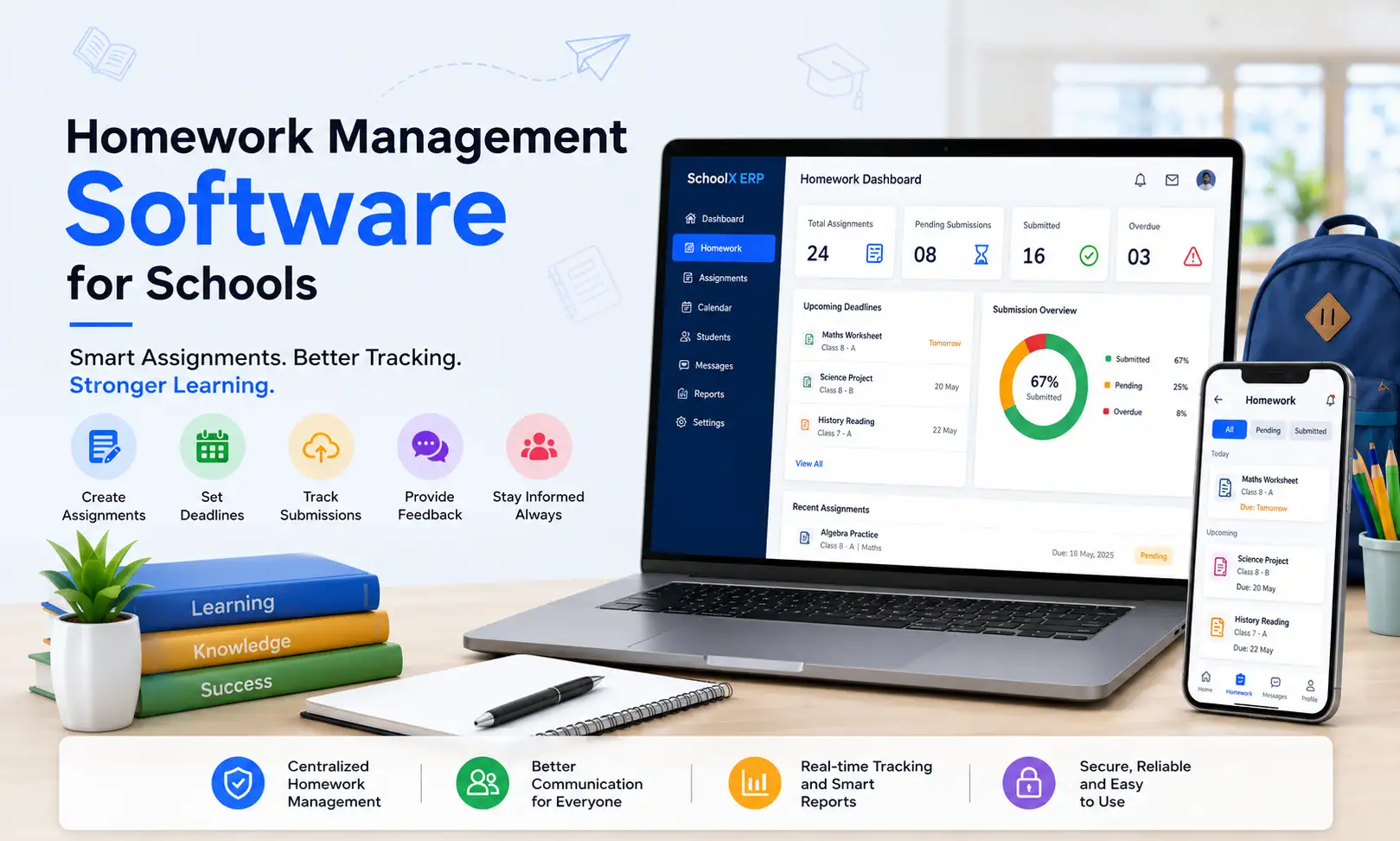
Homework Management Software: A Complete Guide for Schools
Key Takeaways & Executive Summary
- Definition: Homework management software is a digital system to create, distribute, monitor, and manage assignments efficiently from a single platform.
- Why It's Needed: Replaces manual tracking with automated organization, improving communication, tracking, and accountability for teachers, students, and parents.
- Key Features: Online homework creation, submission tracking, assignment deadlines, digital attachments, parent visibility, and reporting.
- Solution: Integrating homework management into a broader system like SchoolX ERP connects assignments directly with other academic and administrative functions.
Table of Contents
- What Is Homework Management Software?
- Why Do Schools Need Digital Homework Management?
- Key Features of Homework Management Software
- Benefits of Homework Management Software for Schools
- Homework Management Software vs Traditional Homework Management
- How to Choose the Right Homework Management Software
- How SchoolX ERP Can Support Homework Management
- Best Practices for Implementing Digital Homework Management
- Frequently Asked Questions (FAQs)
Homework is an important part of the learning process, but managing homework manually can become difficult for teachers, students, and parents. Teachers need to create assignments, share instructions, track submissions, review student work, and provide feedback. Students need to know what work is due and when it has to be submitted. Parents also want visibility into their child's academic activities through a parent-facing school app.
A homework management software helps schools bring these activities into one digital platform. Instead of relying on notebooks, printed worksheets, messaging groups, or multiple applications, schools can use a centralized school management system to create, distribute, monitor, and manage homework efficiently.
Modern school management platforms such as SchoolX ERP can integrate homework management with other academic and administrative functions — including academics, communication, and admissions — giving teachers, students, parents, and school administrators a more organized way to manage daily academic activities.
What Is Homework Management Software?
Homework management software is a digital system that helps schools and teachers manage the complete homework and assignment process. It allows teachers to create homework, assign it to specific classes or students, set deadlines, attach learning resources, monitor submissions, and provide feedback — all within a school academics management workflow.
For students, the system provides a central place to view pending assignments, instructions, deadlines, and submission requirements. Parents can also stay informed about their child's homework and academic activities via a school mobile app or parent portal.
Unlike traditional homework management, where information may be spread across notebooks, classroom notices, and messaging applications, digital homework management keeps assignment-related information organized in one place — similar to how a school ERP centralizes all school operations.
A school can use homework management software for activities such as:
- Daily homework assignments
- Subject-wise assignments
- Projects and activities
- Worksheets
- Reading tasks
- Practice exercises
- Online submissions
- Assignment deadlines
- Teacher feedback
- Homework completion tracking
Why Do Schools Need Digital Homework Management?
Traditional homework management can create unnecessary administrative work. Teachers may spend time writing assignments repeatedly, maintaining submission records, and following up with students who have not completed their work.
Students can also miss assignments because instructions were written in a notebook or communicated through different channels. Parents may not always know what homework has been assigned or whether their child has completed it.
A digital homework management system addresses these challenges by providing a centralized platform. Schools that have adopted a school management software often find homework tracking much easier to implement alongside other modules.
Teachers can publish assignments digitally, students can access them from their devices, and parents can receive better visibility into academic activities. School administrators can also monitor homework-related activities across classes and subjects.
The goal is not simply to replace notebooks with an application. The bigger advantage is better organization, communication, tracking, and accountability. Schools that pair homework management with a robust school communication platform see even greater results in parent engagement.
Key Features of Homework Management Software
The usefulness of homework management software depends on the features it provides. A well-designed system should support the complete homework lifecycle, from assignment creation to completion and feedback.
1. Online Homework Creation
Teachers should be able to create homework directly from the school management system. They can enter assignment instructions, select a subject and class, and specify a submission deadline.
This reduces repetitive manual work and makes assignments easier for students to access.
2. Class and Subject-Wise Assignments
Teachers often need to assign different homework to different classes, sections, or subjects. Homework management software allows assignments to be organized according to academic requirements.
For example, a mathematics teacher can assign one worksheet to Class 8A while assigning a different activity to Class 8B.
This makes assignment management more structured and reduces confusion.
3. Assignment Deadlines
Deadlines help students understand when homework needs to be completed. Teachers can specify due dates while creating assignments.
Students can then view upcoming and overdue tasks, helping them prioritize their academic work.
4. Digital File Attachments
Some assignments require additional resources such as PDFs, images, worksheets, presentations, or reference documents.
A homework management system can allow teachers to attach relevant learning materials along with assignment instructions. Students can access the required resources from the same platform instead of searching through different communication channels.
5. Student Submission Tracking
One of the biggest advantages of digital homework management is submission tracking.
Teachers can see which students have submitted their assignments and which students still have pending work. This reduces the need to maintain separate spreadsheets or manually check multiple notebooks.
Submission tracking can also help teachers identify students who regularly miss assignments.
6. Teacher Feedback
Homework should not end when a student submits an assignment. Feedback helps students understand their mistakes and improve their work.
A digital system can provide teachers with a structured way to review submissions and share comments, corrections, or suggestions.
7. Parent Visibility
Parents play an important role in supporting students at home. A homework management system can give parents better visibility into assignments, deadlines, and completion status.
This can make communication between schools and families more transparent without requiring teachers to send individual messages for every assignment.
8. Homework Notifications
Students and parents can easily miss deadlines when homework information is communicated manually.
Notifications and reminders can help users stay aware of newly assigned homework and upcoming deadlines. This is especially effective when integrated with a school communication software that sends alerts via SMS, email, or app push notifications.
9. Homework History
Maintaining a digital record of previous assignments can make academic information easier to access.
Teachers can refer to previous homework, while students may revisit earlier assignments or learning materials when preparing for examinations.
10. Homework Reports and Tracking
School administrators may need an overview of homework activity across classes and subjects. A school administrative software with reporting capabilities makes this much simpler.
Reporting features can help identify assignment completion patterns, pending submissions, and other academic activity. Such information can support teachers and administrators in identifying areas that require attention.
Benefits of Homework Management Software for Schools
Implementing a digital homework management system can benefit different stakeholders across the school.
Benefits for Teachers
Teachers can reduce the time spent on repetitive administrative tasks. Assignments can be created and distributed digitally instead of being repeatedly written or communicated through separate channels.
Submission tracking also makes it easier to identify incomplete homework and follow up with students, similar to how academic management software tracks exam results and grades.
Most importantly, teachers can spend more time on teaching and feedback instead of maintaining manual homework records.
Benefits for Students
Students get a centralized location for their assignments. They can check what homework has been assigned, review instructions, access attachments, and keep track of deadlines.
Digital access can also reduce the possibility of losing homework instructions or forgetting assignments that were communicated earlier.
Benefits for Parents
Parents can gain better visibility into their child's academic activities. Instead of depending entirely on notebooks or messages from teachers, they can check assigned homework and deadlines through the school's digital platform.
This can make it easier for parents to support their children with homework and maintain regular communication with the school. Explore how school communication software enables seamless parent-teacher interaction.
Benefits for School Administrators
Administrators can gain greater visibility into academic activities across different classes and subjects.
A centralized system can also reduce dependence on disconnected tools and manual records. When homework management is integrated with a broader school management software, academic information can be managed more systematically. See how a complete school ERP system with 30+ modules can transform school operations.
Homework Management Software vs Traditional Homework Management
Traditional homework management generally depends on notebooks, printed worksheets, classroom announcements, and messaging platforms. While these methods can work for small-scale requirements, they become harder to manage as the number of students and classes increases.
A digital homework management system provides a more centralized approach.
| Traditional Homework Management | Digital Homework Management |
|---|---|
| Written instructions | Digital assignment instructions |
| Manual submission tracking | Online submission tracking |
| Separate communication channels | Centralized communication |
| Difficult to track pending work | Easier completion tracking |
| Physical worksheets | Digital attachments |
| Limited parent visibility | Better parent access |
| Manual records | Digital homework history |
| More administrative work | Automated organization |
Digital systems do not necessarily eliminate every manual activity, but they can significantly improve how homework information is organized and communicated.
How to Choose the Right Homework Management Software
Schools should not choose a system simply because it has a long list of features. The software should solve actual problems faced by teachers, students, parents, and administrators.
Consider the following factors before selecting a solution.
Ease of Use
Teachers should be able to create and manage assignments without complicated procedures. A system that is difficult to use may reduce adoption even if it offers many features.
Mobile Accessibility
Students, teachers, and parents may access homework from different devices. Mobile-friendly access is therefore important for modern schools. Check out the SchoolX mobile app to see what a strong mobile experience looks like for a school platform.
Integration with School ERP
Homework management becomes more useful when it works as part of a broader school ERP. Integration with academic management, communication, fee management, and HR modules can reduce the need to maintain separate systems.
Notifications and Communication
Check whether the platform provides effective notifications and communication features so that students and parents can stay informed about assignments and deadlines.
Reporting
Schools should evaluate whether the system provides useful reports for teachers and administrators. Reports should help identify pending work and overall assignment activity — much like how school administrative software generates reports for operational oversight.
Data Security
Academic information is sensitive. Schools should evaluate how the software handles student information, account access, backups, and data protection.
Scalability
The system should be able to support the school's current requirements while also accommodating future growth in students, teachers, classes, and academic activities.
How SchoolX ERP Can Support Homework Management
SchoolX ERP is designed as a school management platform that brings different academic and administrative activities into a centralized system. Its homework management capabilities can help schools organize assignment-related activities for teachers, students, and parents.
Instead of managing homework separately from other school operations, schools can connect homework activities with their broader academic management workflow, alongside fee collection and admissions.
For teachers, this can provide a structured way to manage assignments and monitor student participation. Students can access their academic tasks more conveniently, while parents can stay informed about homework activities.
The larger benefit comes from having homework management as part of a broader school ERP system, where academic information and communication can be managed through a connected platform. Read our comparison of the top 10 smart school ERP software in India to understand how platforms differ.
Best Practices for Implementing Digital Homework Management
Technology alone will not solve poor homework management. Schools should establish clear processes for using the system. For a broader digital transition, see our guide on how to choose the right school ERP software.
First, teachers should follow consistent naming and assignment practices so students can easily understand what each task requires.
Second, deadlines should be clearly defined. Assignments without clear submission requirements can create unnecessary confusion.
Third, teachers should provide meaningful feedback rather than using the software only as a method for distributing homework.
Schools should also introduce teachers, students, and parents to the platform before full implementation. Short training sessions and clear guidelines can improve adoption.
Finally, administrators should periodically review homework activity and gather feedback from teachers and students. This can help the school identify problems and improve its digital academic workflow.
Frequently Asked Questions (FAQs)
Homework management software is a digital platform that helps schools create, assign, distribute, track, collect, and manage homework and assignments.
It can reduce manual work by allowing teachers to create assignments digitally, share resources, track submissions, manage deadlines, and provide feedback from a centralized system.
Yes. Depending on the platform, parents can view assigned homework, deadlines, submission status, and other academic information through a parent portal or mobile application.
It can be useful for schools of different sizes because digital assignment management can improve organization and communication. The appropriate features depend on the school's academic workflow and requirements.
Yes. Homework management can be included as part of a broader school ERP platform, allowing schools to connect assignments with other academic and communication functions.
Conclusion
Managing homework manually may appear simple, but it can become increasingly difficult as schools grow and academic activities become more complex. Teachers need to manage assignments and submissions, students need clear access to their tasks, and parents need better visibility into academic activities.
Homework management software provides a centralized approach to creating, distributing, tracking, and managing assignments. Features such as digital homework creation, deadlines, file attachments, academic tracking, parent notifications, feedback, and reporting can make the overall process more organized.
For schools looking to digitize academic operations, homework management can be an important component of a complete school ERP and school management software solution. You can also explore how other schools have benefited by reading our guide on the top 30 essential modules of a modern school ERP.
The right platform should not simply digitize existing paperwork. It should make homework easier to manage, easier to track, and easier for teachers, students, and parents to understand. Ready to get started? Book a free demo with SchoolX today and see how homework management fits into a full-featured school ERP.