
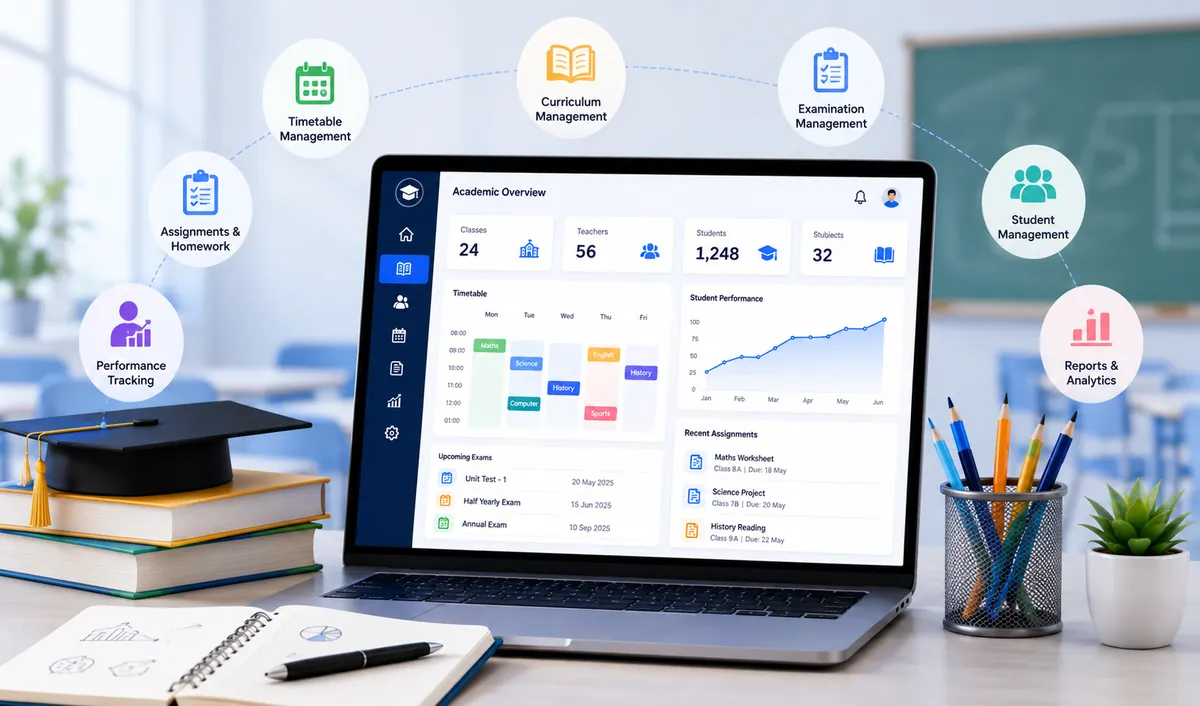
Academic Management Software for Schools: Features, Benefits & Complete Guide
Key Takeaways & Executive Summary
- Definition: Academic management software is a centralized digital platform for organizing and managing academic operations including classes, subjects, timetables, homework, examinations, attendance, and student performance.
- Core Purpose: It connects academic planning, student information, attendance, homework, examinations, and performance tracking in one system — replacing disconnected registers, spreadsheets, and separate applications.
- Key Features: Academic year planning, class & section management, subject management, curriculum planning, timetable management, homework management, attendance integration, examination management, performance tracking, and academic reports.
- Solution: SchoolX ERP integrates academic management into a full-platform ERP — so academic activities connect directly to fee collection, HR, and communication for a unified school management workflow.
Table of Contents
- What Is Academic Management Software?
- Why Do Schools Need Academic Management Software?
- Key Features of Academic Management Software
- Benefits of Academic Management Software for Schools
- Academic Management Software vs Manual Academic Management
- How to Choose the Right Academic Management Software
- How SchoolX ERP Supports Academic Management
- Best Practices for Implementing Academic Management Software
- Frequently Asked Questions (FAQs)
Managing academic activities is one of the most important responsibilities of a school. From planning the academic year and managing subjects to organizing classes, assignments, examinations, and student performance, schools handle a large amount of academic information every day.
When these activities are managed through registers, spreadsheets, separate applications, and manual communication, teachers and administrators can spend significant time maintaining records instead of focusing on education.
Academic management software provides a centralized digital platform for organizing and managing these activities. It helps schools connect academic planning, student information, attendance, homework, examinations, and performance tracking in one system.
For schools looking to modernize their academic operations, academic management software can become an important component of a complete school ERP and school management software solution.
What Is Academic Management Software?
Academic management software is a digital system designed to help schools manage their academic operations from a centralized platform.
It can help administrators and teachers organize information related to classes, sections, subjects, academic schedules, curriculum, homework, examinations, attendance, and student performance.
Instead of maintaining separate records for different academic activities, schools can manage related information through one connected system.
For example, a teacher may need to manage a particular class, subject, timetable, homework assignments, attendance, and examination results. With an integrated academic management system, these activities can be connected to the same student and class records.
A school can use academic management software for:
- Academic year planning
- Class and section management
- Subject management
- Curriculum planning
- Timetable management
- Homework and assignment management
- Attendance management
- Examination management
- Student performance tracking
- Academic reports
- Teacher and student communication
Why Do Schools Need Academic Management Software?
Academic administration becomes more complicated as the number of students, teachers, classes, and subjects increases.
A school may have multiple sections for each grade, different subject teachers, changing timetables, regular assessments, homework, attendance records, and examination schedules. Managing all of this manually can lead to duplicated work and disconnected information.
Academic management software helps bring these activities into a structured digital environment.
Instead of searching through different files or spreadsheets, teachers and administrators can access relevant academic information from a centralized platform.
This can help schools:
- Reduce repetitive administrative work
- Organize academic information
- Improve communication between teachers and administrators
- Monitor student progress
- Simplify academic reporting
- Manage schedules more efficiently
- Improve access to student records
- Connect different academic activities
The objective is not simply to digitize paperwork. A well-designed academic management system should help schools create a more organized and connected academic workflow.
Key Features of Academic Management Software
The features available can vary between platforms, but a comprehensive academic management system should support the major activities involved in managing school academics.
1. Academic Year Planning
Schools need to organize their academic activities before a new session begins.
Academic management software can help administrators structure classes, sections, subjects, teachers, academic calendars, and other requirements for the new academic year.
Centralizing this information can make the transition between academic sessions more organized.
2. Class and Section Management
Schools often have multiple classes and sections with different teachers and students.
A digital academic management system allows administrators to maintain class and section information in an organized manner. Teachers can then access the students and subjects relevant to their responsibilities.
This reduces the need to maintain separate class lists manually.
3. Subject Management
Subject management is another important part of academic administration.
Schools can organize subjects according to classes, sections, academic sessions, and teachers. This provides a structured foundation for other activities such as timetables, homework, examinations, and performance tracking.
4. Curriculum Management
Schools need to plan what students should learn throughout the academic year.
Curriculum management features can help schools organize academic content, subjects, topics, and learning plans.
Teachers can use this information to structure their teaching activities and keep track of academic progress throughout the session.
5. Timetable Management
Creating a school timetable manually can be time-consuming, particularly when a school has many classes and teachers.
Academic management software can help organize class schedules, subject periods, teacher assignments, and room requirements.
A centralized timetable also makes it easier for teachers and students to access their schedules.
6. Homework and Assignment Management
Homework is an important part of the academic workflow.
Teachers can create assignments, provide instructions, set deadlines, attach learning resources, and track submissions through an integrated homework management system.
When homework management is connected with academic records, schools can manage assignments without relying on separate communication channels.
7. Attendance Integration
Attendance provides important information about student participation.
An academic management platform can connect attendance records with student information and other academic activities.
This allows teachers and administrators to access attendance information alongside other records instead of maintaining completely separate systems.
8. Examination Management
Examinations require planning, scheduling, marks management, and result preparation.
Academic management software can help schools organize examination schedules, subjects, assessments, marks, grades, and result records.
Integrating examination management with student records also makes it easier to track academic performance over time.
9. Student Performance Tracking
Recording marks is only one part of academic management. Schools also need to understand how students are progressing.
Performance tracking features can help teachers monitor student results across assessments and subjects.
When performance data is connected with attendance, homework, and examination records, teachers can gain a broader view of student progress.
10. Academic Reports
Schools regularly need academic reports for students, teachers, parents, and administrators.
A centralized system can simplify report generation by using information already stored in the platform.
Reports may include examination results, attendance, academic progress, assignments, and other relevant information.
Benefits of Academic Management Software for Schools
A digital academic management system can provide benefits to different stakeholders.
Benefits for Teachers
Teachers spend a significant amount of time managing academic records and administrative tasks.
Academic management software can help teachers access class lists, timetables, student information, homework, attendance, and examination records from one platform.
This can reduce repetitive administrative work and allow teachers to focus more on teaching, assessment, and student support.
Benefits for Students
Students need easy access to academic information such as timetables, homework, assignments, examination schedules, and results.
A centralized digital platform can make this information easier to access.
Students can also benefit from better visibility into their academic progress and upcoming activities.
Benefits for Parents
Parents need information about their child's academic activities and progress.
Through a parent portal or mobile application, parents can potentially access homework, attendance, examination results, academic reports, and other relevant information.
This can improve communication between schools and families and help parents stay involved in their child's education.
Benefits for School Administrators
Administrators need a broad view of academic operations.
A centralized academic management system can provide information about classes, subjects, teachers, student performance, examinations, attendance, and other academic activities.
This can support better planning and reduce dependence on disconnected spreadsheets and manual records.
Academic Management Software vs Manual Academic Management
Manual academic management can become difficult when schools handle large amounts of information.
| Manual Academic Management | Digital Academic Management |
|---|---|
| Paper-based records | Centralized digital records |
| Separate spreadsheets | Connected academic information |
| Manual timetable management | Digital timetable management |
| Repetitive data entry | Reusable student and class records |
| Manual report preparation | Faster report generation |
| Difficult information sharing | Easier access for authorized users |
| Limited performance analysis | Academic analytics and tracking |
| Multiple communication channels | Centralized academic communication |
Digital systems do not remove the need for teachers and administrators. Instead, they can reduce repetitive administrative work and give them better access to information.
How to Choose the Right Academic Management Software
Schools should evaluate software based on their actual academic requirements instead of choosing a platform solely because it offers a large number of features. (For a more detailed framework, see our guide on how to choose the right school ERP software.)
Ease of Use
Teachers and administrators should be able to use the system without extensive technical knowledge.
If basic tasks such as creating assignments, entering marks, or checking student records are unnecessarily complicated, adoption can become difficult.
Integration with School ERP
Academic management is connected to many other school activities.
A solution that integrates academic management with student management, attendance, homework, examinations, fees, communication, and performance tracking can provide a more complete school management environment. (See our breakdown of the top 30 essential modules of a modern school ERP system.)
Reporting and Analytics
Schools should look for meaningful reports that help teachers and administrators understand academic performance and operational trends.
Reports should support decision-making rather than simply displaying large amounts of information.
Mobile Accessibility
Teachers, students, and parents increasingly use smartphones to access school information.
A mobile-friendly academic management system can make important information accessible beyond the school computer. You can also compare which school ERP apps work best on Android and iOS.
Data Security
Academic and student information should be protected through appropriate security measures.
Schools should evaluate user permissions, authentication, backups, data access controls, and other security capabilities before selecting a platform.
Scalability
The software should be capable of supporting the school's current requirements as well as future growth.
Schools should consider whether the system can handle additional students, teachers, classes, sections, and academic activities without becoming difficult to manage.
You can also compare leading platforms side-by-side in our review of the top 10 smart school ERP software in India.
How SchoolX ERP Supports Academic Management
SchoolX ERP is designed to bring academic and administrative activities into a centralized school management platform.
By connecting academic management with other school ERP modules, schools can manage related activities through a more unified workflow.
Teachers can access student and class information, manage academic activities, assign homework, track attendance, and review examination results. Students and parents can also access relevant academic information through digital interfaces.
The benefit of an integrated approach is that schools do not have to maintain completely separate systems for every academic activity.
For example, homework, attendance, examinations, and student performance can be connected to the same student records. This can give teachers and administrators a more complete view of academic progress.
Because academic management sits inside the same platform as fee collection, HR, and communication (rather than as a separate product), data doesn't need to be manually reconciled between systems.
If your school is currently managing academic activities across spreadsheets, paper files, or a patchwork of disconnected tools, our School ERP Software page covers the full platform, or you can book a free demo to see how academic management works together in practice.
Best Practices for Implementing Academic Management Software
Implementing software does not automatically improve academic administration. Schools also need a clear process for using the system.
First, schools should identify the academic activities that currently consume the most administrative time. These should be prioritized during implementation.
Second, teachers and administrators should receive proper training before the system is introduced across the school.
Third, schools should maintain consistent data entry practices. Incorrect or outdated student and academic information can reduce the usefulness of reports.
Schools should also clearly define user roles and access permissions. Teachers, administrators, students, and parents do not need access to the same information.
Finally, schools should regularly review how the software is being used and collect feedback from teachers and other users. This can help identify areas where the academic workflow can be improved. (If you're transitioning from spreadsheets, see our guide on migrating from Excel to a school ERP.)
Frequently Asked Questions (FAQs)
Academic management software is a digital platform that helps schools manage academic activities such as classes, subjects, curriculum, timetables, homework, attendance, examinations, student performance, and academic reports.
It gives teachers centralized access to student information, timetables, attendance, assignments, examinations, and academic records, reducing the need for separate manual systems.
Yes. Depending on the platform, parents can access information such as homework, attendance, examination results, and academic reports through a parent portal or mobile application.
Academic management software focuses primarily on academic activities, while a complete school ERP generally covers both academic and administrative functions. Academic management can therefore be an important module within a school ERP.
Yes. Many systems can store examination results, assessment marks, grades, assignments, and other academic information to help teachers monitor student progress.
Conclusion
Managing academic activities involves much more than maintaining examination marks. Schools need to coordinate classes, subjects, curriculum, timetables, homework, attendance, examinations, student performance, and academic reports.
Academic management software provides a centralized way to organize these activities and connect information across different academic processes.
For teachers, it can reduce repetitive administrative work and provide easier access to student information. For students, it can make academic activities and schedules easier to access. For parents, it can improve visibility into their child's education. For administrators, it can provide a more organized view of academic operations.
When academic management is integrated with a broader school ERP and school management software platform, schools can create a connected digital environment where student records, homework, attendance, examinations, performance, and communication work together.
The goal should not simply be to replace paper records with software. The real objective is to create a more organized, accessible, and efficient academic management process that allows schools to spend less time managing information and more time improving education. If you're ready to see how it works, book a free demo with SchoolX today.