
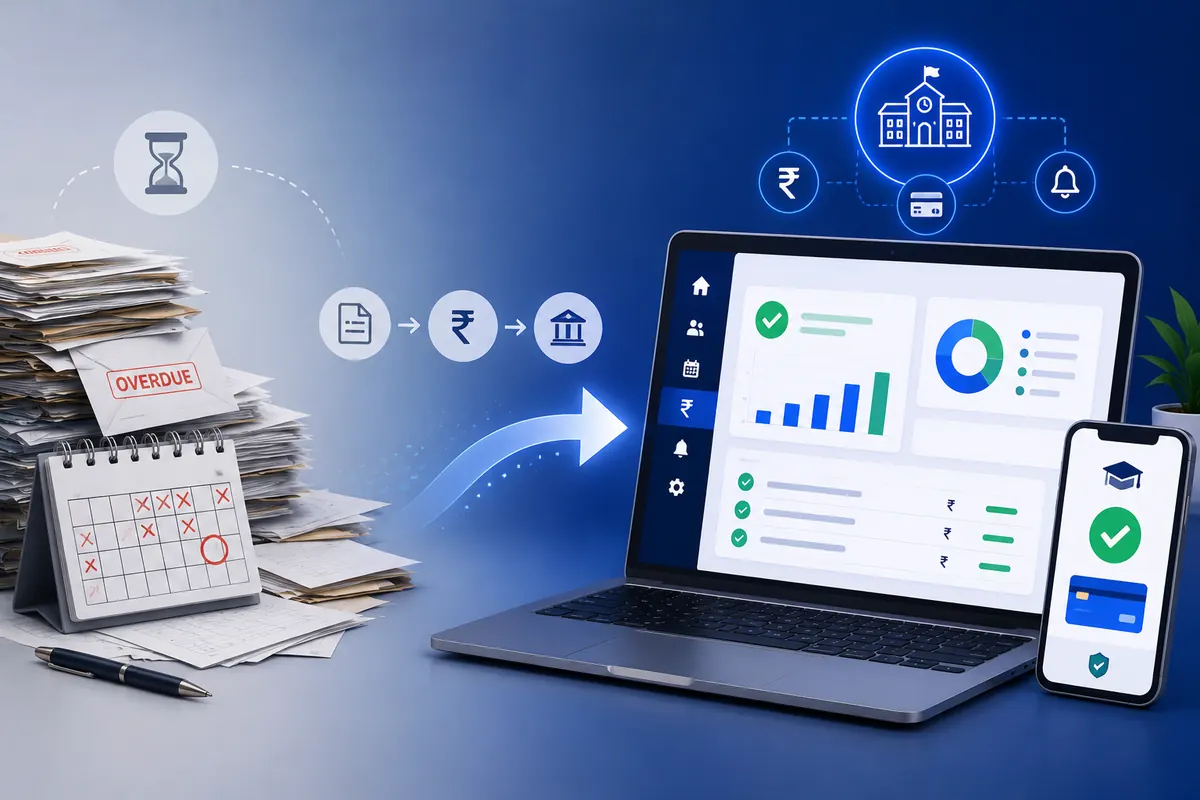
How to Reduce Fee Collection Delays in Schools
Key Takeaways & Executive Summary
- Root Cause: Fee delays are a process problem — not a parent problem. Manual reminders, limited payment options, and poor visibility are the real culprits.
- Top Strategies: Automated reminders, online payments, flexible installments, real-time dashboards, and consistent late fee policies.
- Impact: Schools using automated fee management typically see fewer overdue accounts within the very first billing cycle.
- Solution: SchoolX ERP's Fee & Finance module automates the entire fee lifecycle from reminders to reconciliation.
Table of Contents
- Why Fee Delays Happen in the First Place
- Strategy 1: Automated Fee Reminders
- Strategy 2: Multiple Online Payment Options
- Strategy 3: Flexible Installment Plans
- Strategy 4: Real-Time Fee Dashboards
- Strategy 5: Late Fee Policies That Work
- How Automation Changes Fee Collection Outcomes
- What Schools Typically See After Switching
- Frequently Asked Questions (FAQs)
Ask any school administrator what eats up the most time and patience in their office, and fee collection is almost always near the top of the list. Not because collecting fees is inherently hard — but because the process most schools still rely on is built for a smaller, simpler era. A manual register someone updates by hand at the end of the day, if they remember to. (If your school is still doing this, here is a guide on migrating from Excel to School ERP).
The result is predictable: delayed payments pile up, cash flow gets unpredictable right when the school needs it most (salaries, vendor payments, exam season expenses), and office staff spend hours chasing down parents who, in many cases, genuinely just forgot — not refused.
The good news is that fee delays aren't really a "parent problem." They're a process problem, and process problems are fixable. Here's what actually works.
Why Fee Delays Happen in the First Place
Before jumping to solutions, it's worth understanding the real root causes, because most schools misdiagnose this issue. Recognizing these challenges is the first step in learning how to choose the right school ERP software for your institution.
Manual reminders that are easy to miss or forget. A single circular sent home in a student's bag, or a phone call made once, competes with dozens of other things parents are juggling. One reminder rarely sticks.
No easy way to pay online. If paying fees means visiting the school office during limited hours, standing in line, and paying by cash or cheque, some parents will simply put it off — not out of unwillingness, but inconvenience.
Zero visibility into who owes what, in real time. Many schools only find out fees are overdue when someone manually reconciles a register at month-end — by which point, the delay has already compounded.
Rigid, all-or-nothing fee structures. Not every family can pay a large lump sum on a fixed date, especially for annual or term-based fees. Without flexible options, some payments simply get stuck. A proper system needs to support these as part of the essential modules of a modern school ERP system.
Inconsistent follow-up. Without a system tracking who's been reminded and who hasn't, some overdue accounts get chased persistently while others fall through the cracks entirely.
Once you see the pattern, the fix becomes obvious: schools that solve fee delays aren't the ones that chase harder — they're the ones that remove friction and build consistency into the process. That's exactly where automation and a proper fee management system make the difference.
Strategy 1: Automated Fee Reminders (SMS, Email, and App Notifications)
The single highest-impact change most schools can make is replacing manual, one-off reminders with automated, multi-channel notifications that go out consistently — without anyone in the office having to remember to send them.
A well-designed system should automatically notify parents:
- A few days before the due date, as a gentle heads-up
- On the due date itself
- At set intervals after the due date if payment hasn't come through
This isn't about being aggressive with parents — it's about consistency. A single missed reminder is easy to forgive; a system that reliably follows up removes the guesswork and dramatically reduces the number of payments that are "late" simply because someone forgot.
This is exactly what SchoolX ERP's Fee & Finance module automates. Instead of office staff manually tracking who needs a reminder and sending messages one by one, SchoolX sends automated SMS, email, and in-app notifications on a schedule the school defines — before, on, and after the due date — so follow-up happens consistently for every student, every time, without adding to your office team's workload.
Strategy 2: Offer Multiple Online Payment Options
If paying school fees still means a trip to campus during office hours, you're adding a real barrier for working parents. The schools that see the fastest improvement in collection timelines are almost always the ones that make paying as frictionless as checking a bank balance on a phone.
At minimum, parents should be able to pay via:
- UPI
- Debit/credit card
- Net banking
- Popular digital wallets
And ideally, all of this should be available directly through a parent app or portal — not a separate, clunky third-party payment page that feels disconnected from the school's own system.
SchoolX ERP integrates payment gateways directly into the platform, so parents can pay fees in a few taps through the SchoolX parent app — no separate logins, no redirecting to unfamiliar payment sites, and payments reflect instantly in the school's fee records without manual reconciliation. If you want to see exactly how this works end-to-end, our School Mobile App page walks through the parent-facing experience. (You can also compare top systems in our review of the Top 10 Smart School ERP Software in India).
Strategy 3: Flexible Installment Plans
Large lump-sum fee structures are one of the quietest causes of delayed payments. A parent who can comfortably manage a monthly or quarterly payment may genuinely struggle to arrange a full annual fee by a single fixed date — and when they can't, the payment simply gets pushed back, sometimes repeatedly.
Offering structured installment options — monthly, quarterly, or term-wise — doesn't just help parents; it smooths out cash flow for the school too, since payments arrive in a steadier, more predictable rhythm instead of one large annual crunch (or one large annual delay).
SchoolX's Fee & Finance Management module lets schools configure flexible fee structures, including installment schedules, class-wise or student-wise fee plans, and automatic tracking of partial payments — so the system does the math and reconciliation, instead of your accounts team manually tracking who's on which payment plan in a spreadsheet.
Strategy 4: Real-Time Fee Dashboards for Admin Staff
One of the most underrated fixes here isn't parent-facing at all — it's giving your own office and finance staff real-time visibility into who's paid, who hasn't, and by how much they're overdue, without waiting for a manual month-end reconciliation.
A good fee dashboard should show, at a glance:
- Total fees collected vs outstanding, updated live
- A defaulter list, sortable by class, section, or how overdue an account is
- Payment trends over time, so administrators can spot patterns early rather than reacting late
Without this kind of real-time view, schools tend to discover fee problems well after they've already become serious — often only when the accountant sits down to close the books for the month.
SchoolX ERP's admin dashboard gives school management and finance staff exactly this kind of live visibility — fee collection reports, defaulter lists, and payment trend analytics, all updated automatically as payments come in, so there's no lag between a payment happening and the school knowing about it.
Strategy 5: Late Fee Policies That Actually Work
A clear, consistently enforced late fee policy can genuinely help — but only if it's applied predictably and communicated clearly upfront. A policy that exists on paper but gets waived inconsistently, or applied differently case by case, teaches parents that deadlines are negotiable, which quietly undermines the whole system.
A few principles that make late fee policies actually effective:
- State the policy clearly at admission, not as a surprise later
- Apply it consistently and automatically rather than relying on staff to remember and manually calculate it
- Keep it proportionate — a late fee that feels punitive can create friction with parents without meaningfully improving collection speed
SchoolX ERP can automatically calculate and apply late fees based on rules the school configures, so the policy is enforced consistently for every student without anyone in the office needing to manually track due dates and calculate penalties one account at a time.
How Automation Changes Fee Collection Outcomes
When you put these pieces together — automated reminders, easy digital payment, flexible plans, real-time visibility, and consistent late fee enforcement — the underlying pattern is the same in every case: automation replaces inconsistency with reliability.
Manual fee collection depends entirely on staff remembering to follow up, chase, and reconcile — every single time, for every single student. That's a lot to ask of any office team, especially a busy one. A proper school ERP doesn't remove the human element from fee management; it removes the inconsistency, so every family gets the same reminders, the same easy payment options, and the same fair, predictable policy — without depending on any one staff member's memory or bandwidth on a given day.
This is precisely the gap SchoolX ERP's Fee & Finance module was built to close — bringing reminders, payments, installment tracking, reporting, and late fee rules into one connected system, instead of scattered across registers, phone calls, and separate payment links.
What Schools Typically See After Switching to Automated Fee Management
Schools that move from manual fee tracking to an automated system generally report the same handful of outcomes: fewer overdue accounts lingering past a month, significantly less staff time spent on manual follow-up calls, and — perhaps most valuable — much better visibility into cash flow, since administrators aren't waiting until month-end to find out where things stand.
If your school is currently managing fees through spreadsheets, registers, or a patchwork of reminder calls, this is usually one of the fastest, most tangible improvements a school ERP delivers — often visible within the very first collection cycle after going live.
See It in Action
If fee collection delays are a recurring headache at your school, explore SchoolX ERP's School Fee Management Software on our homepage to see how the Fee & Finance module works alongside attendance, admissions, and communication in one unified platform — or book a free demo and we'll walk through exactly how automated reminders, online payments, and real-time reporting would work for your school's specific fee structure.
Frequently Asked Questions (FAQs)
Not when they're well-timed and consistent. Most parents appreciate a clear, predictable reminder schedule far more than an unexpected phone call after a payment is already significantly overdue — automation actually tends to improve the parent experience, not strain it.
Yes — a good school ERP, including SchoolX, allows schools to configure fee structures by class, section, or even individual student (for scholarships, sibling discounts, or special arrangements), rather than forcing a single rigid fee plan across the entire school.
Many schools notice a meaningful reduction in overdue accounts within the very first billing cycle after go-live, since automated reminders and easier payment options address the two biggest causes of delay almost immediately.
With SchoolX ERP, fee payment happens directly within the same parent app used for attendance, homework, and school communication — so there's no need for parents to juggle a separate payment app or portal.
Final Thoughts
Fee collection delays don't have to be an unavoidable part of running a school. The schools that solve this problem aren't the ones that chase harder — they're the ones that build a system where consistency, convenience, and visibility replace manual effort. If you're ready to stop chasing and start collecting, get in touch with us for a free demo today!