
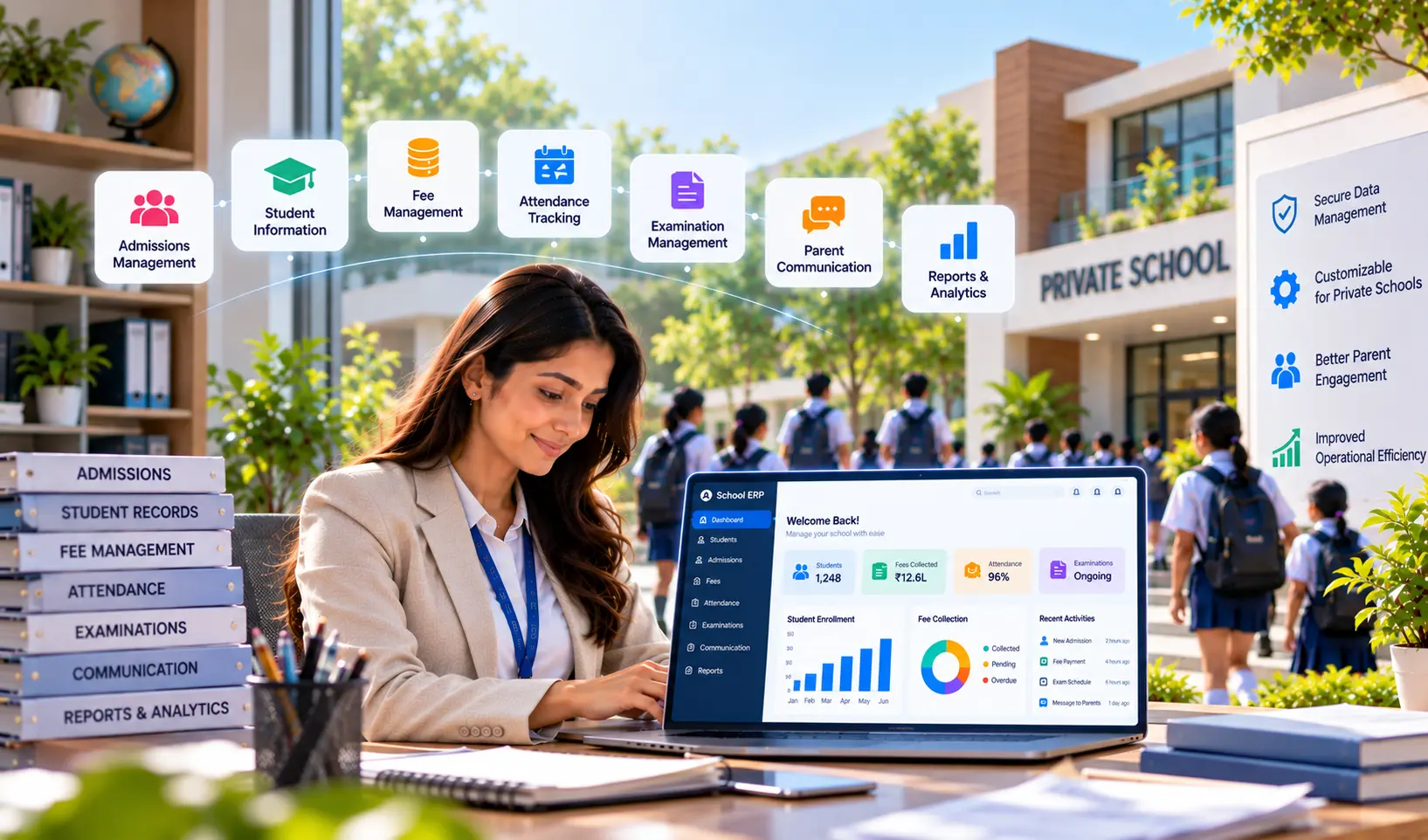
School ERP for Private Schools: Features, Benefits & Selection Guide
Key Takeaways & Executive Summary
- Dual Role: A private school operates as both an educational institution and an independent small business that relies directly on tuition fees to fund teacher salaries and campus infrastructure.
- Revenue-Critical Features: Admissions enquiry tracking, multi-tier flexible fee management, parent communication apps, and automated payroll represent the highest-ROI modules for private schools.
- Parent Experience Matters: Direct fee-paying parents expect smooth digital services. A user-friendly mobile app and responsive communication protect the school's reputation and word-of-mouth recommendations.
- Growth-Ready Solution: SchoolX ERP brings admissions, fees, academics, transport, HR, and multi-branch management together on the cloud with dedicated on-campus implementation support.
Table of Contents
A private school is a school and a small business at the same time, and that's what makes its software needs a little different. Most unaided private schools depend on fees to cover salaries, buildings and everything else. They compete for admissions, often with several schools within a few kilometres. And their parents, who are paying directly, tend to have strong opinions about how the school is run.
None of that changes what a school ERP basically is. But it changes which parts matter most. This guide looks at features, benefits and how to choose, from the point of view of a private school.
What Makes Private School Needs Different
While state-run and grant-aided institutions follow standardized government schedules, private unaided schools operate under real commercial dynamics:
- Fee collection is the cash flow. When fees arrive late, salaries and bills still come due on schedule. A late-fee problem that a school with other funding could absorb can seriously strain a private school.
- Admissions are the pipeline. Enrolment drives revenue, so how a school handles enquiries, follows up with prospective parents and moves them through the process directly affects its numbers.
- Parents judge the experience. Because parents are paying customers in a very literal sense, the quality of communication, the ease of paying fees and the clarity of information shape the school's reputation, including by word of mouth.
- Budgets are real. Many private schools have limited IT budgets and no dedicated technical team, so software has to be usable by ordinary office staff without constant outside help.
- Growth is usually a goal. Adding sections, classes or a second campus is common, so the system has to grow with the school rather than get in its way.
The Features That Matter Most
Admissions and Enquiry Management
Look for a system that records enquiries, tracks follow-ups, accepts online applications and documents, and shows where each prospective family is in the process. If your school gets enquiries by phone, WhatsApp and walk-in, make sure they all end up in one place. SchoolX's admission management module covers this, including lead tracking and follow-ups.
Fee Management and Collection
This is probably the single most important module. You want flexible fee structures (by class, by student, with sibling discounts and concessions), online payment options, automatic reminders, clear defaulter reports, and receipts that generate themselves. The aim is to reduce the hours your accounts team spends chasing money. See fee management.
Parent Communication and App
A good parent app handles fee payment, attendance, homework, circulars and messages in one place. For a private school, this is part of the product you're offering. Communication tools and the mobile app should feel like a service, not an afterthought.
Financial Reporting
Private school owners and directors usually want a clear picture of collections, pending dues, and how the numbers compare across classes or months. Reports that need no manual assembly save time and support better decisions.
Staff Management and Payroll
Salaries are typically the largest cost. Attendance-linked payroll, leave tracking and digital payslips cut mistakes and keep staff confident that they'll be paid correctly.
Transport
If you run buses, transport management with route records and parent notifications is a visible service that parents notice.
Multi-Branch Support
If you run more than one campus, or plan to, check how the system handles several branches: separate data with combined reporting, shared setups where useful, and one place to oversee everything.
A Web Presence
Admissions often start with a Google search. A professional website is part of the funnel, which is why schools that subscribe to SchoolX and don't have a website get a free basic one (see website designing).
What a Private School Gets Out of It
- Steadier cash flow: Reminders and easy online payment shorten the time between invoice and payment.
- A smoother admissions process: Fewer enquiries lost between a phone call and a form.
- Less admin workload: Reduces repetitive manual entry, which matters most for schools running lean offices.
- A better parent experience: Seamless digital interactions that support student retention and school reputation.
- Clearer numbers: Owners and principals can see what's happening without waiting for someone to compile it.
- Room to grow: New sections, classes, or branches can be added without redoing everything.
How to Choose: A Practical Guide
When selecting an ERP for an independent or private institution, keep this evaluation sequence in mind:
- Start with money and admissions. If a system is weak at fees and enquiries, nothing else will make up for it in a private school.
- Test it with your own fee structure. Real schools have odd ones: sibling discounts, transport slabs, staff-child concessions, staggered installments. Ask the vendor to set up yours in the demo.
- Ask about total cost. Find out what's included in the subscription, what implementation costs, and whether features you'll want later are extras. Get it in writing so you can compare vendors fairly.
- Watch the office staff, not just the demo presenter. If your accounts person can't use it comfortably in a trial, adoption will be a struggle.
- Check support quality. Fee deadlines and admission seasons are when problems hurt. Ask how support works then.
- Ask about growth. What happens when you add a branch or double your students?
- Speak to other private schools. Ask a similar-sized private school what it's like to use the system day to day, including during fee season.
For a more general checklist that applies to any school, see our guide on choosing the right school ERP.
Common Mistakes
- Choosing the cheapest option: Only to discover that fee features and reporting capabilities are severely limited.
- Focusing on features nobody will use: Prioritizing gimmicks instead of the essential tools that affect daily operations and revenue.
- Skipping training for office staff: Forgetting that administrative staff do most of the daily work and need proper onboarding.
- Treating the parent app as optional: Underestimating parent expectations in an era where digital communication is standard.
- Not planning for a second campus: Waiting until an expansion is already underway before considering multi-branch architecture.
How SchoolX Fits a Private School
SchoolX is a cloud-based ERP covering admissions, fees, academics, communication, HR and payroll, transport, RFID attendance and inventory in one connected system, with apps for parents, teachers and administrators. It supports multi-branch management for schools with more than one campus.
Our team handles setup, data migration and staff training, and visits your campus rather than working only remotely. See implementation support. To see it with your own fee structure, you can book a free demo, or browse the School ERP Software page first.
Frequently Asked Questions (FAQs)
Usually yes, especially for fee collection and parent communication, since those directly affect cash flow and reputation. The key is choosing a system sized sensibly for your school and making sure staff will actually use it.
Fee management and admissions tend to deliver the most visible return for private schools. Many start there and add other modules over time.
Yes, many systems, including SchoolX, support multi-branch management. Check how data and reporting are separated and combined for your particular setup.
The core software is the same. What differs is emphasis: admissions, fee collection and parent experience tend to matter more for private schools because they directly affect revenue and reputation.
It depends on size and how organised your records are, but most schools move through setup, migration, training and a parallel run over several weeks.