
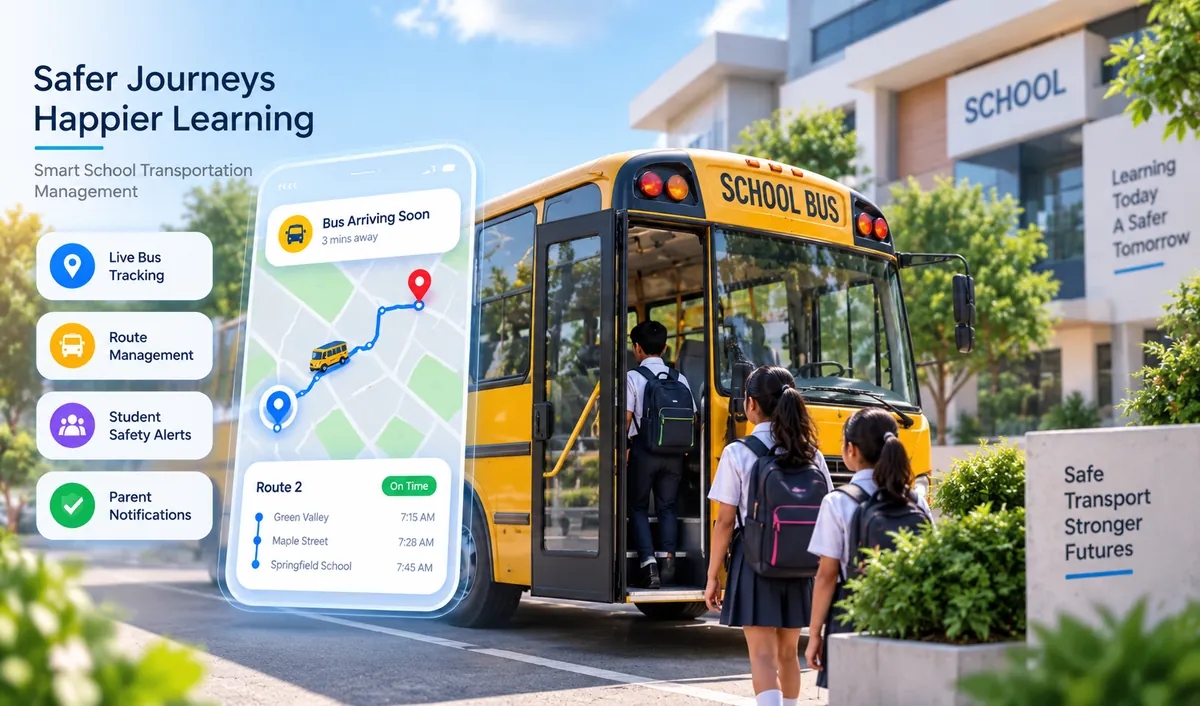
School Transport Management Software: GPS Tracking, Routes & Parent Alerts
Key Takeaways & Executive Summary
- The Problem: Transport is often the last part of school operations to get digitized — many schools still coordinate bus routes with printed sheets and phone calls, despite already automating admissions, fees, and attendance.
- What It Does: School transport management software centralizes route planning, GPS tracking, student boarding logs, driver/vehicle records, and automated parent notifications into one system.
- Must-Have Features: Real-time GPS tracking, route optimization, student boarding/alighting tracking (RFID), automated parent alerts, driver & vehicle management, route deviation & speed alerts, and fuel/cost tracking.
- Solution: SchoolX ERP's Transport module is built into the same platform as fees, academics, and communication — parents track buses in the same SchoolX app used for everything else, with RFID-based boarding tracking and instant notifications.
Table of Contents
- What Is School Transport Management Software?
- Why Manual Transport Coordination Breaks Down
- Key Features to Look for in School Transport Software
- How GPS Bus Tracking Actually Improves Safety
- Route Optimization: More Than Just Convenience
- What to Ask Before Choosing Transport Software
- How SchoolX Handles School Transport
- Frequently Asked Questions (FAQs)
For any school running a bus fleet, transportation is one of the highest-stakes parts of the day — not because it's complicated in theory, but because it involves the physical safety of every student, twice a day, across routes that change with traffic, weather, and last-minute absences. A single missed pickup or an unclear delay can turn into dozens of anxious parent phone calls within minutes.
Yet transport is often the last part of school operations to get digitized. Many schools that have already automated admissions, fees, and attendance are still coordinating bus routes with a printed route sheet and a driver's mobile number. School transport management software exists specifically to close this gap — bringing the same visibility and automation to student commutes that schools now expect from every other part of their operations.
What Is School Transport Management Software?
School transport management software is a digital system that manages every aspect of a school's transportation operations — route planning, vehicle and driver records, real-time GPS tracking, student boarding/alighting logs, and automated parent notifications — all from a centralized dashboard rather than scattered spreadsheets, WhatsApp groups, and phone calls.
Instead of a transport coordinator manually tracking which bus is running late or which route needs adjusting, the system provides live visibility: where every vehicle is, whether it's on schedule, and instant alerts the moment something changes.
Why Manual Transport Coordination Breaks Down
Schools running transport without dedicated software tend to run into the same recurring problems, regardless of fleet size:
No real-time visibility. If a bus is delayed due to traffic or a mechanical issue, the school office often only finds out when a parent calls asking where the bus is — reactive, not proactive.
Route planning is manual and rarely optimized. Routes drawn up once, years ago, often stay unchanged even as student addresses shift — leading to longer, less efficient routes than necessary, and higher fuel costs.
Parent anxiety and repeated phone calls. Without automated updates, parents have no way to know if a bus is running late except by calling the school directly — a drain on office staff time that compounds daily, across every route.
Safety gaps. Manually tracking which students boarded which bus, and confirming safe drop-off, is difficult to verify consistently without a digital system — a real concern for younger students especially.
Vehicle and driver records scattered. Vehicle maintenance schedules, insurance renewal dates, and driver license validity often live in separate paper files or spreadsheets, making it easy to miss a renewal deadline.
If your school is still coordinating transport through phone calls and printed sheets, the same principles that apply to migrating from Excel to a school ERP apply here — the longer manual processes persist, the harder the eventual transition becomes.
Key Features to Look for in School Transport Software
Not every transport tool on the market covers the same ground. Here's what a genuinely useful system should include:
Real-Time GPS Tracking
Live vehicle location visible to both school administrators and parents, so everyone knows exactly where a bus is at any moment — not just its scheduled time.
Route Planning and Optimization
Tools to design, adjust, and optimize bus routes based on student addresses, minimizing distance and travel time while maximizing seat utilization across the fleet.
Student Boarding and Alighting Tracking
RFID or app-based confirmation of which students boarded and disembarked at each stop, creating an accurate, auditable record rather than relying on a driver's memory.
Automated Parent Notifications
SMS, app, or push notifications alerting parents when the bus departs, approaches their stop, or experiences a delay — removing the need for phone calls to the school office.
Driver and Vehicle Management
Centralized records for driver licenses, vehicle documents, insurance, and maintenance schedules, with alerts before any of these expire.
Route Deviation and Speed Alerts
Notifications if a vehicle deviates from its assigned route or exceeds a safe speed threshold — an important safety layer beyond simple location tracking.
Fuel and Cost Tracking
Reports on fuel consumption, distance traveled per route, and overall transport costs, helping schools identify inefficiencies and control expenses over time.
How GPS Bus Tracking Actually Improves Safety
Real-time GPS tracking does more than satisfy parent curiosity — it creates a genuine safety layer that manual coordination simply can't match.
If a bus breaks down or is delayed unexpectedly, the school knows immediately rather than waiting for a phone call, and can notify affected parents proactively. If a vehicle deviates from its planned route — whether due to a driver error or something more serious — an alert flags it instantly rather than going unnoticed until someone happens to ask. And because boarding and alighting are logged digitally, schools have an accurate, timestamped record of exactly which students were on which bus at any given time, which matters both for day-to-day safety and for resolving any dispute after the fact.
This is also where GPS tracking connects naturally with RFID technology — many schools now issue RFID cards that students tap when boarding and exiting the bus, automatically logging attendance and triggering the parent notification, without any manual entry required from the driver or attendant.
Route Optimization: More Than Just Convenience
Route planning might seem like a one-time setup task, but student addresses change every year as new students join and others move. A route optimized five years ago is rarely still the most efficient one today.
Good transport software can recalculate optimal routes based on current student addresses, minimizing total distance traveled and reducing the number of vehicles needed for a given number of students. Beyond the obvious fuel savings, shorter, better-optimized routes mean less time on the road for students — directly reducing exposure to traffic-related risk and getting children home faster.
What to Ask Before Choosing Transport Software
- Does it integrate with your existing ERP, or does it operate as a separate, disconnected tool? Transport data (like fee-linked transport charges) often needs to connect with your broader fee management system.
- Does the parent-facing tracking work through the same app parents already use for attendance and fees, or does it require installing a separate app?
- Can it scale with your fleet — a system that works for 5 buses should still perform reliably at 50.
- Does it support offline scenarios, such as brief GPS signal loss in certain areas, without losing tracking continuity?
For a broader checklist on evaluating integrated school platforms, see our guide on how to choose the right school ERP software.
How SchoolX Handles School Transport
SchoolX ERP's Transport module is built into the same platform as your school's core operations — not a separate, disconnected system. Real-time GPS tracking, route management, and driver/vehicle records all live alongside attendance, fees, and communication, so transport data connects naturally with the rest of your school's information.
Parents track their child's bus in real time through the same SchoolX mobile app used for attendance, homework, and fee payments — no separate app to install. Combined with RFID-based boarding and alighting tracking, schools get automatic attendance logging on buses along with instant parent notifications, without requiring manual entry from drivers or transport staff.
If your school currently manages transport through spreadsheets, phone calls, or a disconnected third-party app, our School Administrative Software page covers how transport fits into the full platform, or you can book a free demo to see real-time tracking and route management in action.
Frequently Asked Questions (FAQs)
Yes — with GPS-enabled transport software, parents can see their child's bus location live through a mobile app, along with notifications for departure, approach, and any delays.
Yes, many systems integrate with RFID to automatically log student boarding and alighting, triggering instant parent notifications without requiring manual attendance marking on the bus.
Yes — route optimization features can reduce total distance traveled by recalculating efficient routes based on current student addresses, which directly lowers fuel consumption and vehicle wear over time.
Most modern systems are designed to handle brief signal loss gracefully, resuming tracking once connectivity is restored, though very remote areas with consistently poor coverage may experience some tracking gaps.
No — it doesn't eliminate the role, but it significantly reduces the manual, repetitive parts of the job (fielding "where's the bus" calls, manually tracking driver documents) so the coordinator can focus on genuine exceptions and planning rather than routine status checks.
Final Thoughts
School transport management isn't just a logistics problem — it's a safety and trust problem. The right software gives schools real-time visibility over every vehicle, removes the guesswork for parents, and creates an auditable record of every student's journey. If you're ready to see how it works, book a free demo with SchoolX today.