
School Performance Tracking Software: Complete Guide to Monitoring Student Performance
Key Takeaways & Executive Summary
- Definition: School performance tracking software is a digital system to collect, organize, and analyze student academic data in one platform.
- Why It's Needed: It helps schools move beyond manual records to actively identify learning gaps and performance trends over time.
- Key Features: Performance dashboards, subject-wise tracking, exam analysis, progress reports, and analytics.
- Solution: A complete system like SchoolX ERP connects performance tracking with attendance, homework, and communication for holistic academic management.
Table of Contents
- What Is School Performance Tracking Software?
- Why Do Schools Need Student Performance Tracking?
- Key Features of School Performance Tracking Software
- Benefits of School Performance Tracking Software
- School Performance Tracking Software vs Manual Tracking
- How to Choose the Right School Performance Tracking Software
- How SchoolX ERP Supports Student Performance Tracking
- Best Practices for Effective Student Performance Tracking
- Frequently Asked Questions (FAQs)
- Conclusion
Schools generate a large amount of academic information every day. Attendance records, examination marks, homework, assignments, classroom activities, and assessment results all provide valuable insights into student progress. However, collecting this information is not enough. Schools need an efficient way to organize, analyze, and use it to understand how students are performing.
School performance tracking software helps schools monitor academic progress through a centralized digital platform. Instead of depending on paper records, spreadsheets, or disconnected systems, schools can use software to track student performance, identify learning gaps, compare academic results, and make informed decisions.
For teachers, it can simplify performance monitoring. For parents, it can provide better visibility into their child's progress. For administrators, it can provide a broader view of academic performance across classes, sections, and subjects.
What Is School Performance Tracking Software?
School performance tracking software is a digital system designed to collect, organize, monitor, and analyze academic performance data of students.
The software can bring information such as examination marks, test scores, assignments, homework, attendance, grades, and other academic records into one centralized platform. This allows teachers and school administrators to monitor performance over time rather than looking at individual records separately.
For example, instead of checking multiple spreadsheets to understand why a student's mathematics performance has declined, a teacher can review the student's examination results, assignment completion, attendance, and previous performance from one system.
The purpose of performance tracking is not simply to display marks. It is to help schools understand student progress, identify weaknesses, recognize improvement, and provide timely academic support.
Why Do Schools Need Student Performance Tracking?
Traditional academic performance tracking often depends on registers, report cards, spreadsheets, and manual calculations. These methods can become difficult to manage when a school has hundreds or thousands of students.
Manual tracking can also make it harder to identify performance trends. A student's marks may look acceptable in isolation but show a consistent decline when compared with previous assessments.
A digital performance tracking system helps schools maintain a continuous record of academic progress.
It can help answer questions such as:
- Which students are struggling in a particular subject?
- Which students have shown significant improvement?
- Which classes are performing well?
- Which subjects have lower average scores?
- Are students with poor attendance also showing weaker academic performance?
- Which students may require additional academic support?
By making this information easier to access, schools can move from simply recording results to actively using data for academic improvement.
Key Features of School Performance Tracking Software
A useful performance tracking platform should provide more than a basic marks entry system. It should help teachers and administrators understand performance from different perspectives.
1. Student Performance Dashboard
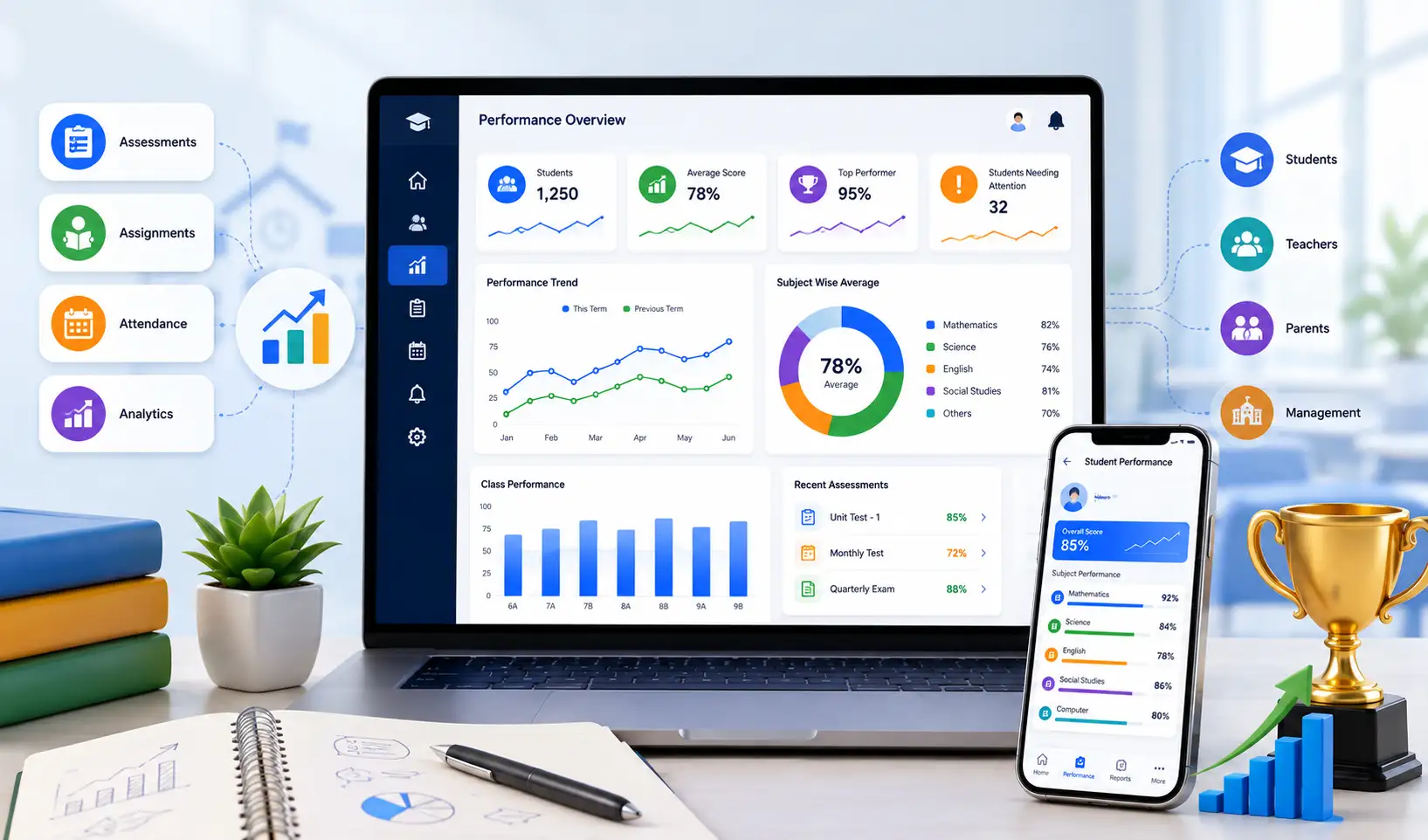
A centralized dashboard can provide an overview of a student's academic performance. Teachers and administrators can quickly review marks, grades, attendance, assignments, and other relevant information.
Visual dashboards can make performance trends easier to understand compared with reviewing multiple paper records.
2. Subject-Wise Performance Tracking
Students may perform differently across subjects. A student who performs well in mathematics may need additional support in English or science.
Subject-wise tracking allows teachers to identify specific areas where students are performing strongly or struggling.
3. Examination and Test Analysis
Examinations and class tests are important sources of academic data. Performance tracking software can store assessment results and help compare marks across different examinations.
Teachers can monitor whether a student's performance is improving, remaining stable, or declining over time.
4. Student Progress Tracking
Performance should be evaluated over time rather than through a single examination.
A digital system can maintain historical academic information, allowing teachers to compare current results with previous assessments. This makes it easier to identify long-term progress and performance trends.
5. Class and Section Comparison
School administrators may need to understand academic performance at the class or section level.
Performance tracking software can provide aggregated information such as average marks, subject performance, or examination results across different sections.
This can help schools identify areas where additional academic attention may be required.
6. Student Performance Analytics
Analytics can turn raw academic data into useful information.
For example, software can help identify students whose performance has consistently declined, students who are improving rapidly, or subjects where a large percentage of the class is struggling.
These insights can support data-driven academic decisions.
7. Attendance and Academic Correlation
Attendance can be an important part of understanding student performance.
When attendance information is connected with academic records, teachers may identify patterns between attendance and academic outcomes. For example, students with frequent absences may require additional support to keep up with classroom learning.
8. Assignment and Homework Tracking
Homework and assignment completion can provide additional information about student engagement.
When performance tracking is connected with homework management, teachers can view academic results alongside assignment activity. This provides a broader understanding of student participation rather than relying only on examination marks.
9. Progress Reports
Schools regularly share academic progress with parents and students.
A digital system can simplify the creation and management of progress reports by bringing relevant academic information together. Reports can provide a clearer picture of student performance across subjects and assessments.
10. Alerts and Academic Intervention
Timely intervention can be important when a student begins to struggle.
A performance tracking system can help teachers identify declining performance and take action earlier. Depending on the software, schools may also use notifications or alerts to draw attention to students who need additional academic support.
Benefits of School Performance Tracking Software
Digital performance monitoring can benefit teachers, students, parents, and school administrators in different ways.
Benefits for Teachers
Teachers often manage performance information for many students at the same time. A centralized system reduces the need to maintain separate records.
Teachers can quickly review individual students, compare performance, identify weak subjects, and monitor progress across assessments.
This can reduce administrative work and give teachers more time to focus on teaching and personalized support.
Benefits for Students
Students benefit from having a clearer understanding of their academic progress.
Performance tracking can help students identify their strengths and areas where they need improvement. When students can see their progress over time, they may also better understand whether their current study approach is producing results.
Benefits for Parents
Parents want to know whether their child is progressing academically.
A digital performance tracking system can provide parents with access to marks, grades, progress reports, attendance, assignments, and other relevant academic information through a parent portal or mobile application.
This creates greater transparency and makes it easier for parents and teachers to communicate about academic concerns.
Benefits for School Administrators
Administrators need to understand academic performance at both individual and institutional levels.
A centralized performance tracking system can provide school-level insights into class performance, subject averages, examination results, and academic trends.
This information can support academic planning, teacher coordination, and targeted intervention programs.
School Performance Tracking Software vs Manual Tracking
Manual performance management can work for small amounts of data, but managing academic information becomes increasingly difficult as the number of students and assessments grows.
| Manual Performance Tracking | Digital Performance Tracking |
|---|---|
| Paper-based records | Centralized digital records |
| Manual calculations | Automated calculations |
| Difficult historical comparison | Easy progress comparison |
| Separate spreadsheets | Connected academic information |
| Limited real-time visibility | Faster access to performance data |
| Time-consuming reporting | Faster report generation |
| Difficult trend analysis | Performance analytics |
| Greater chance of data entry errors | More structured data management |
The purpose of digital tracking is not to replace teachers' judgment. Instead, it gives teachers better access to information that can support their decisions.
How to Choose the Right School Performance Tracking Software
Schools should evaluate a performance tracking system based on actual academic requirements rather than choosing a platform only because it has many features.
Ease of Use
Teachers should be able to enter marks, review student records, and access reports without complicated procedures. A system that requires extensive technical knowledge can make adoption difficult.
Integration with School ERP
Performance tracking becomes more useful when integrated with a complete school ERP. Attendance, homework, examinations, student records, academic management, and communication can work together instead of remaining isolated.
Analytics and Reporting
Schools should look for useful analytics rather than simply attractive dashboards. The system should help teachers and administrators understand trends and identify students who may require attention.
Mobile Accessibility
Teachers and parents may access academic information from smartphones or tablets. Mobile-friendly access makes performance information easier to review when needed.
Data Security
Student academic records are sensitive. Schools should evaluate user permissions, account security, data backups, and other measures used to protect student information.
Scalability
The software should support the school's current student population and be capable of handling future growth without requiring a complete system replacement.
How SchoolX ERP Supports Student Performance Tracking
SchoolX ERP brings academic and administrative functions into a centralized school management platform. Performance tracking can become more effective when academic results are connected with other student information.
Teachers can use centralized records to review student performance across subjects and assessments. When homework, attendance, examinations, and academic records are managed through a connected system, teachers can gain a broader understanding of student progress.
Parents can also receive greater visibility into their child's academic activities, while administrators can review performance information across classes and sections.
The advantage of integrating performance tracking into a broader school ERP system is that schools do not have to depend on isolated spreadsheets or separate applications for different academic activities.
Best Practices for Effective Student Performance Tracking
Software is only one part of an effective performance management strategy. Schools also need clear processes for using academic data.
First, teachers should regularly update student performance records. Outdated information can make reports less useful and delay intervention.
Second, schools should focus on trends instead of relying on a single test score. One poor examination does not necessarily indicate a long-term academic problem.
Third, performance data should be used to support students rather than simply rank them. Teachers can use the information to provide additional practice, personalized guidance, or academic intervention where necessary.
Schools should also maintain communication between teachers and parents. When parents understand a student's strengths and challenges, they can provide appropriate support at home.
Finally, administrators should periodically review performance data at the class and school levels to identify broader academic trends.
Frequently Asked Questions (FAQs)
School performance tracking software is a digital system that helps schools monitor, organize, and analyze student academic performance across subjects, assessments, assignments, attendance, and other academic activities.
It allows teachers to access student records, monitor progress, identify weak subjects, compare assessment results, and generate reports without maintaining multiple manual records.
Yes. Depending on the platform, parents can access academic results, progress reports, attendance, assignments, and other information through a parent portal or mobile application.
Yes. Performance tracking systems can store examination and test results and provide subject-wise, student-wise, class-wise, or historical performance analysis.
It can be. Many modern school ERP platforms integrate performance tracking with student management, attendance, homework, examinations, communication, and other academic modules.
Conclusion
Understanding student performance requires more than recording examination marks. Schools need to monitor progress continuously and connect information from assessments, attendance, homework, assignments, and other academic activities.
School performance tracking software provides a centralized way to collect and analyze this information. Features such as performance dashboards, subject-wise analysis, examination tracking, progress reports, student performance analytics, and academic alerts can help schools make better use of their data.
For teachers, the benefit is easier performance monitoring. For students, it provides greater visibility into their progress. For parents, it improves transparency. For administrators, it provides a broader view of academic performance across the school.
As schools continue to adopt digital systems, integrating performance tracking into a complete school ERP and school management software platform can make academic management more organized, connected, and data-driven.
The goal should not be to collect more data simply for the sake of reporting. The real value comes from using academic data to identify problems early, understand student progress, and provide the right support at the right time.