
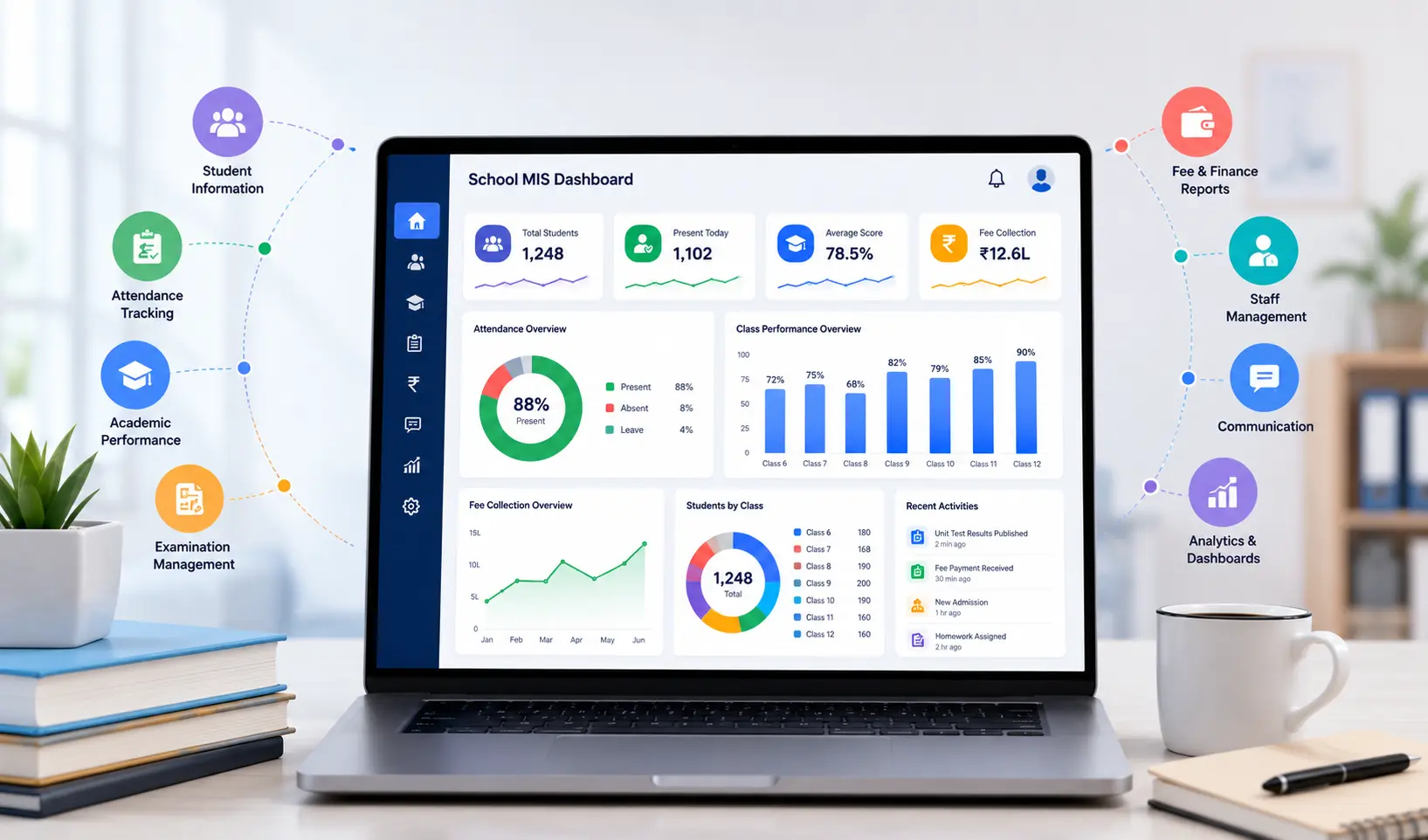
School MIS Software: Complete Guide to School Management Information Systems
Key Takeaways & Executive Summary
- Definition: School MIS software is a digital platform that helps schools collect, store, manage, analyze, and report information related to academic and administrative operations.
- Why It's Needed: Schools generate large amounts of data daily — a centralized MIS turns that data into actionable reports and insights for better decision-making.
- Key Features: Student information management, attendance reports, academic management, examination analysis, performance analytics, fee management, dashboards, and more.
- MIS vs ERP: MIS focuses on information and reporting; school ERP covers broader operations — modern platforms often integrate both.
- Solution: SchoolX ERP integrates MIS capabilities with a complete school management platform for connected reporting and analytics.
Table of Contents
- What Is School MIS Software?
- Why Do Schools Need a Management Information System?
- Key Features of School MIS Software
- Benefits of School MIS Software
- School MIS vs School ERP: What's the Difference?
- Manual MIS vs Digital School MIS Software
- How to Choose the Best School MIS Software
- How SchoolX ERP Can Support MIS and Reporting
- Best Practices for Implementing a School Management Information System
- Frequently Asked Questions (FAQs)
- Conclusion
Managing a school involves much more than teaching students. School administrators and principals need to manage student records, attendance, examinations, academic performance, fees, teachers, communication, and hundreds of other activities. When this information is stored across paper registers, spreadsheets, and disconnected applications, it becomes difficult to get a clear picture of how the school is performing.
School MIS software provides a centralized digital system for collecting, organizing, analyzing, and reporting school information. A modern School Management Information System (SMIS) helps schools turn daily operational data into useful information for teachers, administrators, principals, and management.
Instead of spending hours preparing reports manually, schools can use a school MIS system to access important information through dashboards, reports, and analytics. Schools that are still relying on Excel spreadsheets can particularly benefit from a structured digital MIS.
What Is School MIS Software?
School MIS software stands for School Management Information System software. It is a digital platform that helps schools collect, store, manage, retrieve, and analyze information related to their academic and administrative operations.
A traditional school may maintain separate records for students, attendance, examinations, fees, staff, and other activities. A school MIS brings relevant information into a centralized system, making it easier to access and analyze.
A modern school management information system may include information such as:
- Student profiles and academic records
- Student attendance
- Examination results
- Student performance
- Homework and assignments
- Teacher and staff records
- Fee collection and outstanding payments
- Class and section information
- Timetables
- Parent communication
- Academic reports
- Management dashboards
- School performance analytics
The purpose of an MIS is not simply to store information. The real value comes from turning school data into actionable reports and insights that can support better decision-making.
Why Do Schools Need a Management Information System?
Schools generate large amounts of information every day. Teachers record attendance, enter marks, assign homework, and evaluate students. Administrative teams manage admissions, fees, staff records, and documentation.
When this information is maintained manually, creating a complete report can require collecting data from several sources.
For example, a principal may want to know:
- Which classes have the highest attendance?
- Which subjects have lower average performance?
- Which students are showing declining academic results?
- How much fee has been collected?
- What amount is still outstanding?
- How many students are enrolled in each section?
- Which academic activities require attention?
A school MIS system can make this information easier to retrieve and analyze. The Government of India's concept note on school management systems also describes school-level MIS as a way to support decision-making through statistics and reports while reducing administrative effort.
Key Features of School MIS Software
A useful school MIS should provide more than basic data storage. It should connect different school operations and make important information easier to understand.
1. Student Information Management
A centralized student database is one of the most important components of a school management information system.
The system can maintain student profiles, admission information, class and section details, parent information, academic history, and other relevant records.
Instead of searching through multiple files, authorized users can access student information from one digital profile. This also creates a foundation for other modules such as attendance, examinations, academic management, and performance tracking.
2. Attendance Management and Reports
Attendance is an important part of school administration and student monitoring.
School MIS software can organize daily attendance records and generate attendance reports for students, classes, sections, and specific periods. Schools using RFID-based attendance systems can further automate this process.
Administrators can use these reports to identify attendance patterns, while teachers can quickly review individual student attendance. When attendance information is connected with academic records, schools can also gain a broader understanding of student participation and performance.
3. Academic Management
A school MIS system can help schools manage academic information such as classes, subjects, curriculum, academic sessions, and student progress.
Academic management becomes more useful when it is connected with examination results, assignments, attendance, and student records.
Instead of treating each activity as a separate process, an integrated system can provide a more complete view of academic operations.
4. Examination and Result Management
Examinations generate important data that schools need to maintain and analyze.
A school management information system can store examination results, marks, grades, subjects, and student performance information. Schools can use this information to generate reports and compare performance across students, subjects, classes, and academic sessions.
This reduces the need to manually calculate and compile examination information every time a report is required.
5. Student Performance Analytics
Simply storing marks does not tell the complete story.
Student performance analytics can help teachers and administrators identify changes in academic performance over time. For example, a school can analyze whether a student's performance is improving, whether a particular subject is causing difficulty, or whether an entire class is performing below expectations.
This makes school performance tracking software and MIS reporting valuable components of modern school management.
6. Fee Management and Financial Reports
School administration also involves financial information.
A school MIS can help organize fee records, payment information, outstanding amounts, and collection reports. Administrators can access reports based on students, classes, sections, fee categories, or specific periods. Schools looking to reduce fee collection delays can particularly benefit from integrated financial reporting.
Connecting financial information with other school records can provide management with a more complete picture of school operations.
7. Homework and Assignment Reports
Homework and assignments generate useful academic information.
A modern MIS can connect homework management software with student and academic records, allowing teachers and administrators to monitor assignment activity.
Schools can track assigned homework, submissions, pending work, and other relevant information. When combined with examination and performance data, assignment information can provide additional context about student participation.
8. Teacher and Staff Information
School management is not limited to students.
A school management information system can also maintain information about teachers and staff, including departments, roles, assigned classes, and other administrative and HR records.
This can help administrators manage staff information more efficiently and access relevant reports when required.
9. Timetable Management
Timetable information is another important part of school administration.
Digital timetable management allows schools to organize classes, subjects, teachers, and periods in a structured format. When timetable information is maintained digitally, teachers and administrators can access schedules more easily and make changes without having to recreate paper-based records.
10. Dashboards and Management Reports
Dashboards are one of the most useful components of modern school MIS software.
Instead of reviewing individual reports, principals and administrators can view important indicators through a centralized dashboard. Depending on the system, dashboards can include:
- Student enrollment
- Attendance trends
- Examination performance
- Academic progress
- Fee collection
- Outstanding fees
- Homework activity
- Class performance
- Other school KPIs
The objective is to make important information visible without requiring administrators to manually compile it.
Benefits of School MIS Software
Better Decision-Making
The biggest benefit of an MIS is improved access to information. Principals and administrators can use reports and analytics to make decisions based on actual school data rather than relying entirely on assumptions. For example, academic performance data can help identify subjects or classes that require additional attention.
Reduced Administrative Work
Preparing reports manually can consume significant administrative time. A digital school MIS system can generate recurring reports from information already stored in the system. This reduces repetitive data collection and manual calculations.
Centralized School Data
A centralized system creates a single place for authorized users to access relevant school information. This can reduce dependence on multiple spreadsheets, registers, and disconnected applications. Schools still using spreadsheets should consider migrating from Excel to a school ERP.
Improved Data Accuracy
Manual data entry and repeated copying between spreadsheets can create inconsistencies. A connected system can reduce unnecessary duplication by allowing information to be reused across different modules. However, software does not automatically guarantee accurate data. Schools still need clear data-entry processes and regular verification.
Faster Reporting
Management may need reports for meetings, academic reviews, financial analysis, or internal planning. With digital MIS reporting, authorized users can access required information more quickly instead of waiting for staff to manually prepare every report.
Better Academic Monitoring
When student records, attendance, examinations, homework, and performance information are connected, teachers and administrators can develop a broader understanding of student progress. This can support earlier identification of students who may require additional academic assistance.
School MIS vs School ERP: What's the Difference?
School MIS software and school ERP software are closely related, but they are not exactly the same.
An MIS primarily focuses on collecting, organizing, analyzing, and reporting information to support management and decision-making.
A school ERP, on the other hand, generally provides a broader operational platform covering multiple academic and administrative processes.
| School MIS | School ERP |
|---|---|
| Focuses heavily on information and reporting | Focuses on managing complete school operations |
| Data analysis and reports are central | Operational modules are central |
| Helps management make decisions | Helps staff execute daily processes |
| Dashboards and analytics | Admissions, fees, attendance, academics, exams, communication and more |
| Uses data from school operations | Creates and manages operational data |
In practice, modern school ERP platforms often include MIS reports and analytics as an integrated component. This means a school does not necessarily need a separate MIS platform if its school ERP software already provides strong reporting and analytics capabilities.
Manual MIS vs Digital School MIS Software
Many schools still rely on Excel spreadsheets, paper registers, and manually prepared reports. These methods may work for limited requirements, but they become increasingly difficult as school data grows. Schools considering a switch can learn more about migrating from Excel to a digital school ERP.
| Manual MIS | Digital School MIS |
|---|---|
| Paper and spreadsheet records | Centralized digital database |
| Manual report preparation | Automated or faster reporting |
| Difficult historical analysis | Easier trend analysis |
| Repeated data entry | Connected records |
| Limited real-time visibility | Faster access to information |
| Higher administrative effort | Reduced repetitive work |
| Difficult cross-module analysis | Integrated school data |
| Limited dashboards | Management dashboards and analytics |
The goal of digital MIS is not to eliminate human decision-making. It is to give school management better information on which to base those decisions. Schools evaluating deployment options can also compare cloud vs on-premise school ERP solutions.
How to Choose the Best School MIS Software
Schools should not choose a system simply because it has a large feature list. The right school MIS software should match the school's actual requirements. For a detailed guide on evaluating platforms, see our article on how to choose the right school ERP software.
Ease of Use
Teachers and administrators should be able to access reports without complicated procedures.
Reporting and Analytics
Look for customizable reports, dashboards, filters, and meaningful analytics rather than only basic data exports.
Integration With School ERP
An MIS becomes more useful when it can access information from student management, attendance, academics, examinations, fees, homework, and other modules.
Data Security
Student and school information should be protected through appropriate authentication, role-based access, permissions, backups, and secure data management.
Mobile Accessibility
Principals, teachers, and parents increasingly access school information from smartphones. Mobile-friendly access can make important information easier to retrieve. Schools can also explore the best school ERP apps for Android and iOS.
Scalability
The system should support the school's current requirements and future growth in students, teachers, classes, and branches.
Custom Reports
Different schools may need different reports. A good MIS should provide flexible reporting options rather than forcing every school to use the same fixed reports.
How SchoolX ERP Can Support MIS and Reporting
SchoolX ERP is designed as a broader school management software platform that can connect academic and administrative activities in one digital environment.
When information from student management, attendance, homework, examinations, academic activities, and other modules is connected, schools can use that information for reporting and management analysis.
For principals and administrators, centralized information can make it easier to review academic and operational activities. Teachers can access relevant student information, while parents and students can access the information intended for them through appropriate interfaces including the SchoolX mobile app.
The key advantage of integrating MIS capabilities with a complete school ERP system is that reporting does not have to depend on manually collecting information from multiple disconnected sources. Instead, reports can be generated from the data already maintained within the school's digital management system.
Best Practices for Implementing a School Management Information System
Successful implementation requires more than purchasing software.
First, schools should identify the information they currently manage manually and determine which processes should be digitized first. Schools migrating from Excel should take special care during this phase.
Second, existing student, teacher, academic, and administrative data should be reviewed before migration. Poor-quality data can lead to poor-quality reports.
Third, schools should define user roles carefully. A teacher, accountant, principal, student, and parent do not require access to the same information.
Training is also important. Teachers and administrative staff should understand how to enter, update, search, and interpret information.
Finally, school management should regularly review the reports being generated. If a report does not support an actual decision or workflow, it should be simplified or replaced. Maintaining strong communication between staff and parents during the transition is also essential.
Frequently Asked Questions (FAQs)
School MIS software is a School Management Information System that helps educational institutions collect, store, manage, analyze, and report school information including student records, attendance, examinations, fees, and academic performance.
MIS primarily focuses on information management, reporting, and decision support, while school management software generally covers broader academic and administrative operations. Modern school ERP platforms often combine both.
MIS reports are structured reports generated from school data. They may include attendance reports, academic performance reports, examination results, fee reports, student records, staff information, and other management information.
MIS gives principals faster access to important information about academic, administrative, and operational performance. This can support more informed decision-making across all areas of school management.
Yes. Student information management is one of the core functions that can be included in a school management information system.
Yes. When academic and examination data are integrated, MIS software can help schools monitor student performance, subject-wise results, class performance, and academic trends.
Yes. School MIS solutions can be adapted to the academic and administrative requirements of Indian schools. The appropriate features depend on the school's size, board, workflows, and reporting requirements. You can explore the top school ERP software options in India for more context.
Conclusion
Schools generate valuable information every day, but data is only useful when it can be organized, understood, and used for decision-making.
School MIS software provides a structured way to collect, manage, analyze, and report school information. From student records and attendance to examinations, academic performance, fees, homework, staff information, and management dashboards, an integrated School Management Information System can reduce repetitive administrative work and improve access to important information.
For teachers, it can simplify access to academic records. For administrators, it can make reporting more efficient. For principals, it can provide a broader view of school performance. For students and parents, it can improve access to relevant academic information through platforms like the SchoolX mobile app.
A modern school MIS system becomes even more valuable when integrated with a complete school ERP and school management software platform. Instead of maintaining separate databases and spreadsheets, schools can build a connected digital environment where operational data can also support reporting and analysis.
The objective should not be to collect as much data as possible. The real value of a school MIS comes from collecting relevant data, presenting it clearly, and turning it into useful information for better school management and better academic decisions.