
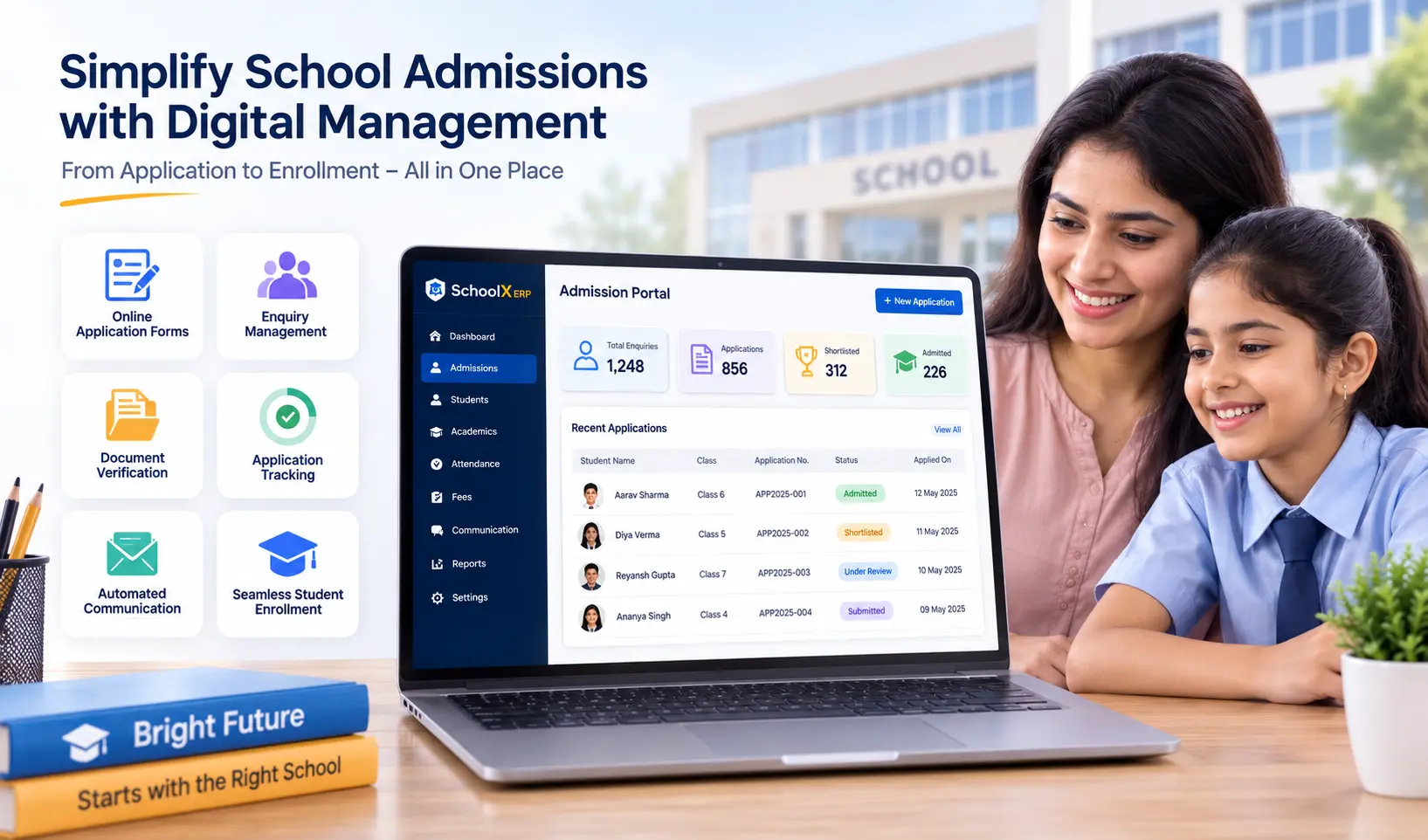
School Admission Management Software: Complete Guide to Digital Admissions
Key Takeaways & Executive Summary
- Purpose: School admission management software provides a centralized digital system for managing enquiries, applications, documents, verification, interviews, selection, and enrollment.
- Key Features: Online admission forms, enquiry management, student registration, application tracking, document management, interview scheduling, status management, fee integration, and automated communication.
- Benefits: Faster admission processing, better organization, reduced admin work, improved parent experience, and fewer data duplication issues.
- Solution: SchoolX ERP connects admission management with student management, academics, attendance, fees, and communication so applicant data flows into the student's permanent record.
Table of Contents
- What Is School Admission Management Software?
- Why Do Schools Need an Admission Management System?
- Problems With Manual School Admissions
- Key Features of School Admission Management Software
- Benefits of School Admission Management Software
- How the Digital Admission Process Works
- School Admission Software for Parents
- How to Choose the Right School Admission Software
- School Admission Software and School ERP
- How SchoolX ERP Supports Admission Management
- Best Practices for Managing Digital Admissions
- Frequently Asked Questions (FAQs)
- Conclusion
Managing school admissions can be a complicated process, especially when applications, student documents, enquiries, interviews, and fee information are handled through paper forms, spreadsheets, emails, and separate records.
As the number of applications increases, administrative teams need a reliable way to track each applicant from the initial enquiry to final admission. School admission management software provides a centralized digital system for managing this process and maintaining student information from the beginning of the admission journey.
A well-designed school admission management system can reduce repetitive administrative work, improve application tracking, organize documents, and make communication with parents more systematic.
What Is School Admission Management Software?
School admission management software is a digital platform that helps schools manage the admission and enrollment process from application to confirmation.
Instead of maintaining separate registers for enquiries, applications, documents, and selected students, schools can manage these activities through one system. Depending on the software, an admission management system may include:
- Admission enquiries
- Online application forms
- Student registration
- Application tracking
- Document collection
- Document verification
- Student interviews
- Application status management
- Admission selection
- Fee or payment information
- Parent communication
- Student record creation
The main purpose is to make the admission process more organized for both the school and parents.
Why Do Schools Need an Admission Management System?
The admission process generates a large amount of information. A school may receive hundreds or thousands of enquiries and applications during an admission cycle. Administrative staff have to keep track of applicant details, documents, application status, communication, and admission decisions.
When this information is managed manually, it can become difficult to know the current status of every applicant. For example, staff may need to answer questions such as:
- How many admission enquiries have been received?
- How many applications are complete?
- Which applicants have missing documents?
- Which students have been shortlisted?
- Which interviews are pending?
- Which students have confirmed admission?
- How many seats are available in each class?
A school admission management system can bring this information into one centralized platform, making it easier for authorized staff to track the admission process.
Problems With Manual School Admissions
Manual admission processes are not automatically wrong, but they become difficult to manage as application volume increases.
Paper-Based Applications
Physical forms require storage space and can take time to organize and retrieve. Finding an old application may require searching through files and registers.
Repeated Data Entry
Applicant information may be entered into multiple spreadsheets or registers. Repeating the same information increases administrative effort and creates opportunities for errors. Schools still relying heavily on spreadsheets may want to explore migrating from Excel to a school ERP.
Difficult Application Tracking
Without a centralized system, staff may have to check different files to determine whether an application is submitted, verified, shortlisted, or approved.
Document Management Problems
Admission requires various documents depending on the school's requirements. Tracking missing or verified documents manually can become difficult when there are many applicants.
Communication Gaps
Parents may need updates about application status, interviews, document requirements, or admission decisions. Managing these communications manually can lead to delays or missed updates.
Key Features of School Admission Management Software
1. Online Admission Forms
An online school admission system can allow parents to submit application information digitally instead of visiting the school to collect and submit physical forms. Schools can create forms according to the information they need during the admission process. Digital forms can also make applicant information easier to transfer into the school's database.
2. Admission Enquiry Management
Not every parent who contacts a school immediately submits an application. An admission management system can maintain enquiry information so that staff can follow up with interested parents. Enquiries can include details such as:
- Parent or guardian information
- Student information
- Class of interest
- Contact details
- Enquiry date
- Current status
- Follow-up information
This provides the admissions team with a more organized way to handle prospective students.
3. Student Registration
Once a parent begins the admission process, the student's basic information can be recorded in the system. A student registration software solution can help schools collect information such as name, date of birth, class applied for, parent details, and contact information.
The registration record can later become the foundation for the student's official school profile if admission is confirmed.
4. Application Tracking
Application tracking is one of the most useful features of digital admission management. Instead of relying on paper files, staff can see the current status of an application. For example:
Enquiry → Application Started → Submitted → Documents Pending → Verified → Shortlisted → Selected → Admission Confirmed
The exact workflow will differ between schools, but having clearly defined stages can make the process easier to manage.
5. Document Management
Admission applications often require supporting documents. A digital school application management system can allow relevant documents to be collected and associated with the applicant's record. Administrators can then check whether the required documents have been submitted and verified.
6. Application Verification
Schools may need to verify the information and documents submitted by applicants before moving them to the next stage. Admission software can provide a structured process for marking applications or documents as pending, verified, or requiring further information.
7. Interview Management
Some schools conduct interviews or assessments as part of the admission process. Software can help administrators organize interview schedules and maintain relevant information about applicants. This is particularly useful when many students are being assessed within a limited period.
8. Application Status Management
Admissions teams need to distinguish between applications at different stages. A digital system can provide statuses such as:
- New enquiry
- Application pending
- Application submitted
- Under review
- Documents pending
- Shortlisted
- Selected
- Waitlisted
- Rejected
- Admission confirmed
Clear status management helps staff understand what action is required next.
9. Fee and Payment Information
Once a student is selected, admission may involve registration or admission fees. Where supported, an admission system can connect payment information with the applicant's record. Integration with school fee management software can make the transition from admission to regular fee management more organized.
10. Automated Communication
Parents may need communication at different stages of the admission process. A digital admission platform can support notifications related to application submission, missing documents, interview schedules, selection, or other important updates.
Automated communication can reduce repetitive work for administrative staff while helping parents receive information on time.
11. Student Record Creation
One of the biggest advantages of integrating admission with a broader school management software platform is the ability to move information from the admission process into the student's official record.
Once admission is confirmed, the school should not have to manually recreate all the student's information from scratch. The admission record can become the starting point for student management, attendance, academics, examinations, and other school activities.
Benefits of School Admission Management Software
Faster Admission Processing
Digital forms, application tracking, and centralized records can reduce the time required to process applications. Staff can quickly identify incomplete applications and focus on the cases that require attention.
Better Organization
Instead of maintaining separate registers for enquiries, applications, and documents, schools can organize relevant information in one system.
Reduced Administrative Work
Automating repetitive activities such as status updates, data organization, and communication can reduce manual workload. This allows admission staff to spend more time handling applicants and resolving actual issues.
Better Parent Experience
Parents can benefit from online applications, clearer communication, and easier access to admission information through a school mobile app or parent portal. A well-designed system can reduce unnecessary visits to the school simply to submit forms or check application status.
Improved Application Visibility
School administrators and principals can get a clearer view of the overall admission process. They can identify how many applications are at each stage and determine where additional administrative attention is needed.
Fewer Data Duplication Issues
When information is entered into a centralized system and reused across connected modules, schools can reduce unnecessary re-entry of the same student information.
How the Digital Admission Process Works
A typical digital admission workflow may look like this:
Admission Enquiry → Registration → Application Form → Document Submission → Verification → Interview/Assessment → Selection → Fee Payment → Admission Confirmation → Student Record
The exact process depends on the school's admission policy. The important point is that each stage can be tracked rather than relying on separate paper records.
For example, if an application is missing a required document, the system can show that the application is incomplete. Once the document is submitted and verified, the application can move to the next stage.
School Admission Software for Parents
The admission process is not only an administrative activity. It is also an important experience for parents. Parents generally want the process to be clear and convenient.
An online admission system can allow parents to:
- View admission information
- Submit applications
- Provide student details
- Upload required documents
- Receive application updates
- Access interview information
- Receive admission decisions
- Complete relevant payment steps
The interface should remain simple. Adding too many forms or complicated steps can make the digital process just as frustrating as a manual one. A mobile app can further improve convenience for parents.
How to Choose the Right School Admission Software
Schools should evaluate software based on their actual admission workflow rather than simply selecting the platform with the largest feature list. For a detailed evaluation framework, see our guide on how to choose the right school ERP software.
Ease of Use
The admissions team should be able to create applications, review records, update statuses, and find information without unnecessary complexity.
Customizable Forms
Different schools may require different information from applicants. The software should provide enough flexibility to support the school's application requirements.
Application Tracking
Staff should be able to understand the current status of every application without checking multiple systems.
Document Management
Check how documents are uploaded, stored, reviewed, and accessed by authorized users.
Communication
The system should support the school's preferred communication methods for important admission updates.
Security and Access Control
Admission records contain personal information about students and parents. Schools should evaluate authentication, permissions, access controls, backups, and other data protection practices before selecting a platform.
Integration With School ERP
Admission software becomes more useful when it connects with the broader school ERP system. Information collected during admission can then be used for student management, attendance, academics, examinations, fees, and other school operations.
School Admission Software and School ERP
Admission is usually the first stage of a student's relationship with a school. Once a student is admitted, the information collected during the application process becomes useful across other school activities. For example:
Admission → Student Management → Attendance → Academics → Examination → Performance Tracking
When these processes are connected through a school ERP, schools can avoid creating the student's information again after admission is completed. This also makes it easier to maintain a continuous digital record throughout the student's time at the school.
Schools considering deployment options should also compare cloud vs on-premise school ERP solutions.
How SchoolX ERP Supports Admission Management
SchoolX ERP provides a connected environment for managing different school activities, including student information and administrative processes.
Admission-related information can become part of the student's broader digital record instead of remaining isolated in a separate admission system. After admission, student information can support connected processes such as student management, attendance, academics, examinations, fees, and communication.
For administrators and principals, this can reduce duplicate data entry and provide a more organized transition from applicant to enrolled student.
The effectiveness of any admission software, however, depends on how well the school defines its admission workflow and how consistently staff maintain the information.
Best Practices for Managing Digital Admissions
Define the Admission Workflow. Before implementing software, schools should clearly define each stage of the admission process. This makes it easier to configure the system according to actual requirements.
Keep Application Requirements Clear. Parents should know which information and documents they need before starting the application. Unclear requirements can result in incomplete applications and additional follow-ups.
Verify Information Before Final Admission. Student and parent information should be reviewed before the admission is confirmed and the official student record is created.
Avoid Duplicate Records. Schools should check whether an applicant already exists in the database before creating a new record. This is particularly important for students who previously submitted enquiries or applications.
Train Admission Staff. Staff should understand how to create applications, update statuses, verify documents, communicate with parents, and complete the admission process. Good software cannot compensate for an unclear process or incorrect data entry.
Frequently Asked Questions (FAQs)
School admission management software is a digital system that helps schools manage enquiries, applications, documents, verification, interviews, selection, admission confirmation, and related communication.
A school admission management system organizes the admission process in one centralized platform and allows authorized staff to track applicants from enquiry to enrollment.
Yes. An online school admission system can allow parents to submit application forms and required information digitally, depending on the school's configuration. Parents can also track progress through a school mobile app.
Yes. Many admission management systems provide document collection and management features for storing and reviewing required application documents.
Yes. When admission management is integrated with a school ERP, information collected during admission can be used to create and maintain the student's broader school record.
It can reduce repetitive administrative work, organize applications and documents, improve application tracking, simplify communication, and provide better visibility into the admission process.
Conclusion
School admissions involve many interconnected activities, from handling initial enquiries and applications to verifying documents, conducting interviews, selecting students, and confirming enrollment.
Managing all of this manually can become difficult as the number of applicants increases.
School admission management software provides a centralized approach to organizing these activities. Online forms, application tracking, document management, verification, communication, and student record creation can make the admission process more structured for school staff and more convenient for parents.
The right solution should not simply automate every possible task. It should fit the school's actual admission workflow, remain easy to use, protect applicant information, and integrate with other important school processes.
When admission management is connected with a broader school ERP, the information collected during application can continue to be useful after the student is enrolled. This creates a smoother transition from applicant to student and helps schools maintain a more organized digital record throughout the student's academic journey.
For schools looking to move away from paper forms, scattered spreadsheets, and disconnected admission records, a well-designed digital admission system can be a practical step toward more efficient school administration.